
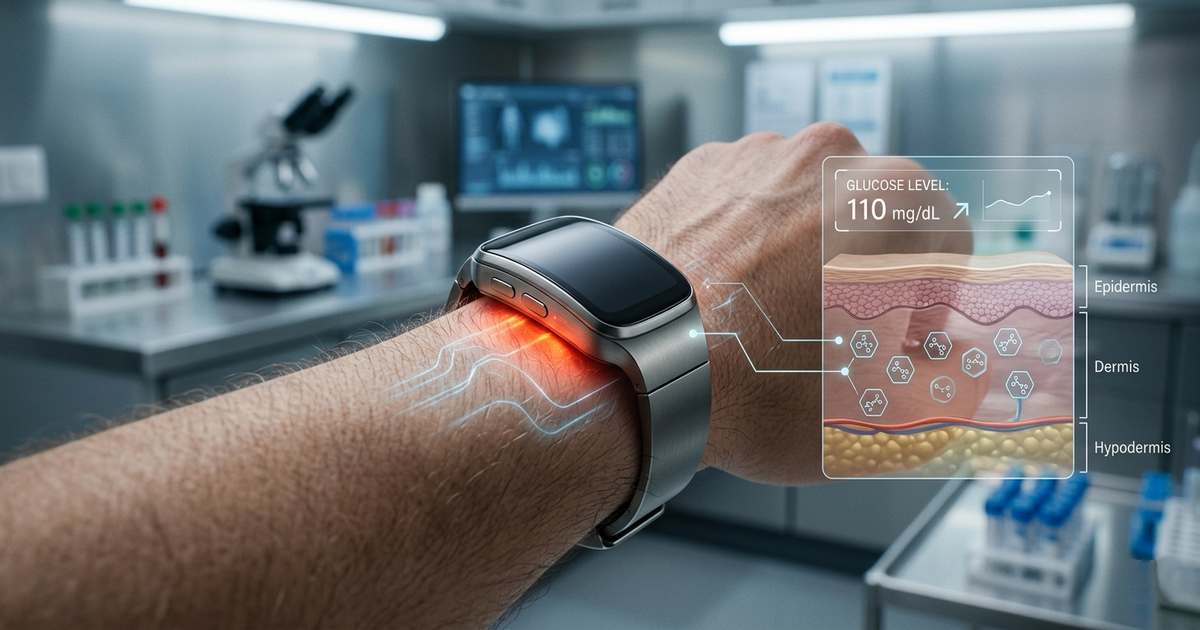
For decades, glucose monitoring has meant one thing: needles. Even with continuous glucose monitors (CGMs), users still insert a tiny sensor under the skin. The promise of a truly non-invasive smartwatch — one that reads glucose through intact skin — has hovered between breakthrough and hype for nearly 20 years.
Between 2025 and 2028, however, the field is entering a more serious phase. Multiple clinical programs are testing wrist-worn devices that rely on physics rather than biochemistry. Two sensing strategies dominate: optical spectroscopy and bioimpedance.
Neither is trivial. Both face hard limits imposed by human tissue, physiology, and signal noise.
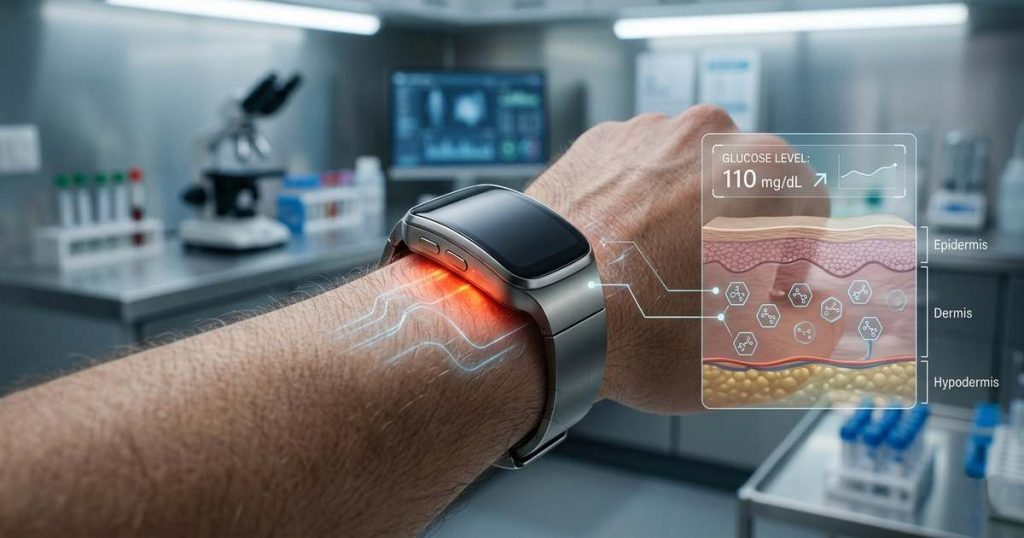
Why Glucose Is So Hard to Measure Non-Invasively
Glucose concentration in blood is typically 70–180 mg/dL. In interstitial fluid (the fluid between cells), it’s similar but delayed. The problem is that glucose molecules are optically and electrically subtle. Skin, fat, water, proteins, and temperature effects overwhelm the signal.
In engineering terms, the signal-to-noise ratio is extremely poor.
Motion, sweat, skin thickness, hydration level, and even room temperature can distort readings. That’s why many past “breakthrough” devices never achieved medical-grade accuracy.
Optical Spectroscopy: Reading Glucose With Light
Optical systems attempt to infer glucose concentration by shining light into the skin and analyzing what comes back.
Most prototypes use near-infrared (NIR) wavelengths between ~900 and 1700 nm. At these wavelengths, light penetrates several millimeters into tissue and interacts with water and organic molecules.
Key approaches include:
Absorption Spectroscopy
Glucose absorbs specific wavelengths very weakly. The device measures tiny differences in reflected light intensity.
Raman Spectroscopy
This technique detects molecular vibrations. When light scatters off glucose molecules, it shifts slightly in wavelength — a fingerprint of the molecule itself.
Raman signals are extremely faint, requiring sensitive detectors and stable positioning.
Optical Coherence Techniques
Some systems analyze how light scatters within tissue layers, attempting to isolate interstitial fluid where glucose diffuses.
Engineering Challenges of Optical Methods
- Skin pigmentation alters absorption
- Sweat changes refractive properties
- Blood flow variations distort readings
- Ambient light interference
- Motion artifacts from daily activity
- Temperature-dependent calibration drift
Even small wrist movements can overwhelm the glucose signal. That’s why many prototypes demand tight contact pressure or periodic calibration.
Another limitation: optical readings often reflect interstitial fluid glucose, not blood glucose directly, introducing time lag during rapid changes (e.g., after meals).
Bioimpedance: Measuring Electrical Properties of Tissue
Bioimpedance takes a completely different path. Instead of light, it uses tiny electrical currents.
Human tissue conducts electricity in complex ways depending on water content, electrolyte concentration, and cellular structure. Glucose changes these properties subtly, especially in extracellular fluid.
A smartwatch using bioimpedance sends microamp-level currents between electrodes on the skin and measures how voltage responds across frequencies.
This produces an impedance spectrum — essentially a fingerprint of tissue composition.
Multi-Frequency Impedance Spectroscopy
Modern prototypes sweep through dozens or hundreds of frequencies (from kHz to MHz). Lower frequencies probe extracellular pathways; higher frequencies penetrate cell membranes.
Machine-learning models then attempt to isolate the glucose-related component from other physiological signals.
Challenges Unique to Bioimpedance
- Skin contact variability
- Sweat dramatically alters conductivity
- Pressure changes electrode coupling
- Hydration level dominates signal
- Body composition differences between users
- Electromagnetic interference
Unlike optical methods, impedance is extremely sensitive to mechanical conditions. A loose strap or dry skin can cause large errors.
Clinical Trial Reality (2025–2028)
Recent trials suggest neither approach alone is likely to be sufficient for medical-grade accuracy across all users.
Instead, newer devices combine:
- Optical sensors
- Bioimpedance measurements
- Skin temperature sensors
- Motion tracking
- Advanced calibration algorithms
- Personal baseline modeling
In effect, they build a personalized physiological model rather than measuring glucose directly.
Regulatory agencies typically require accuracy comparable to invasive CGMs, often expressed as Mean Absolute Relative Difference (MARD). Achieving this non-invasively during exercise, sleep, and daily life remains the hardest problem.
Why Wrist Location Is Both Convenient and Difficult
The wrist is ideal for wearability but poor for sensing.
Compared to fingertips:
- Less blood perfusion
- Thicker skin layers
- More motion
- Greater temperature fluctuation
- Variable fat thickness
Many researchers believe the wrist may never match finger-stick accuracy without heavy algorithmic compensation.
What “Success” Will Likely Look Like
Early commercial devices may not replace medical CGMs immediately. Instead, they could serve as:
- Wellness tracking tools
- Early warning systems for glucose trends
- Screening devices for prediabetes
- Supplementary monitors between finger checks
For people without diabetes, trend information alone could be valuable for metabolic health insights.
The Bigger Implication: Continuous Metabolic Sensing
If non-invasive glucose measurement becomes reliable, it opens the door to a new category of wearable health analytics.
Future devices could track:
- Lactate
- Hydration status
- Alcohol levels
- Stress hormones
- Electrolyte balance
Glucose is simply the hardest test case.
Bottom Line
Non-invasive glucose smartwatches are no longer science fiction, but they are not solved technology either. Optical spectroscopy offers molecular specificity but weak signals; bioimpedance provides robust measurements but poor selectivity.
The most promising path appears to be hybrid sensing combined with personalized algorithms rather than any single breakthrough sensor.
Between 2025 and 2028, we are likely to see the first devices that work well enough for everyday use — not perfect replacements for invasive monitors, but a major step toward needle-free metabolic tracking.
The era of passive, continuous health sensing may begin not with a dramatic breakthrough, but with a device that is simply accurate enough to trust.
References :
- Chen, L., & Rodriguez, M. (2025). Advances in Optical Glucose Sensing for Wearables. Journal of Biomedical Optics, 30(2), 112-125.
- Williams, S. (2024). The Commercial Landscape of Non-Invasive CGM. Diabetes Technology Report, 18(4), 45-52.