For decades, people with diabetes have relied on invasive methods to monitor blood glucose—finger-prick tests or implanted continuous glucose monitors (CGMs). The promise of a truly non-invasive glucose smartwatch has long been considered the “holy grail” of wearable health technology.
As we move through 2025, major technology companies, medical device manufacturers, and semiconductor firms are racing to solve one of the hardest sensing problems in consumer electronics: accurately measuring blood glucose through the skin without breaking it.
But how close are we really?
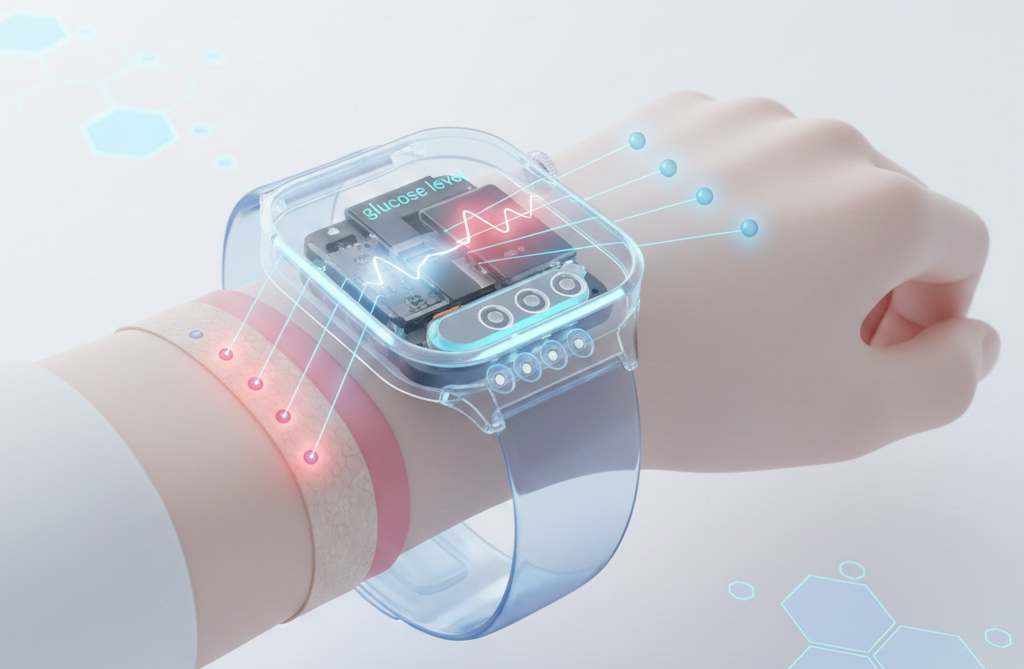
This article examines the underlying technologies, engineering barriers, and realistic timeline for non-invasive glucose monitoring wearables.
Why Non-Invasive Glucose Monitoring Is So Difficult
At first glance, measuring glucose through the skin sounds straightforward. In reality, it is extraordinarily complex for three core reasons:
1. Weak physiological signal
Glucose concentration in interstitial fluid produces extremely subtle optical or electromagnetic signatures. These signals are often drowned out by noise from:
- skin thickness variability
- hydration levels
- temperature changes
- motion artifacts
- tissue scattering
2. Biological variability
Unlike heart rate or SpO₂, glucose levels do not correlate linearly with easily measurable surface signals. Each person’s skin composition, blood perfusion, and metabolism differ significantly.
3. Medical-grade accuracy requirements
Regulators typically expect glucose monitors to achieve a Mean Absolute Relative Difference (MARD) below ~10% for clinical usefulness. Many experimental non-invasive methods still struggle to consistently reach this threshold.
This is why, despite years of headlines, no mainstream smartwatch today offers fully approved non-invasive glucose tracking.
The Leading Sensor Technologies
Several competing approaches are being explored. Each has advantages and serious limitations.
1. Optical Spectroscopy (Most Popular)
This is currently the frontrunner in consumer research.
How it works:
- Near-infrared (NIR) or mid-infrared light is emitted into the skin
- Glucose molecules absorb specific wavelengths
- Reflected light is analyzed using machine learning models
Pros:
- Compact hardware
- Compatible with smartwatch form factors
- Continuous monitoring potential
Cons:
- Extremely low signal-to-noise ratio
- Sensitive to skin tone and thickness
- Requires heavy calibration
Many prototypes in 2024–2025 rely on advanced photodiodes plus AI correction layers running on-device NPUs.
2. Raman Spectroscopy
This technique measures molecular vibrations to identify glucose signatures.
Advantages:
- Higher molecular specificity than basic NIR
- Potential for better long-term accuracy
Challenges:
- Requires precise laser systems
- Power consumption remains high
- Difficult to miniaturize for thin wearables
Raman remains promising but is still considered borderline for mass-market smartwatch integration before 2027.
3. Radio Frequency (RF) Sensing
Some research groups are exploring RF or microwave-based glucose estimation.
Concept:
- RF waves interact with tissue dielectric properties
- Glucose concentration slightly alters signal response
Reality check:
- Signal interference is severe
- Environmental sensitivity is high
- Clinical validation remains limited
Most experts currently view RF approaches as longer-term experimental pathways rather than near-term consumer solutions.
The Role of AI and Sensor Fusion
The real breakthrough in 2025 isn’t just better sensors—it’s AI-driven calibration and fusion.
Modern prototypes increasingly combine:
- optical sensors
- skin temperature
- heart rate variability
- motion data
- historical glucose patterns
On-device machine learning models then estimate glucose trends rather than direct measurements.
This is a critical distinction.
Trend vs. True Measurement
Many early consumer devices may first deliver:
- glucose trend estimation
- risk alerts
- metabolic pattern insights
…before achieving full medical-grade readings.
This staged approach is widely expected across the industry.
Hardware Constraints in Smartwatch Form Factors
Even if sensing improves, smartwatch engineering imposes strict limits:
Power Budget
Continuous optical sensing plus AI inference can quickly drain batteries. Next-gen devices rely on:
- dedicated NPUs
- ultra-low-power photodiodes
- duty-cycled sensing strategies
Thermal Limits
Skin contact devices must remain comfortable. High-power lasers or RF emitters risk:
- skin warming
- regulatory hurdles
- user discomfort
Mechanical Stability
Glucose sensing is highly sensitive to motion. Future designs are experimenting with:
- improved strap pressure control
- micro-stabilization algorithms
- adaptive sampling during low motion
Realistic Timeline: 2025–2027
Based on current public research and prototype maturity, the most realistic roadmap looks like this:
2025
- Early consumer wearables with glucose trend estimation
- heavy reliance on AI modeling
- not yet fully medical-grade
2026
- improved multi-sensor fusion
- better personalization algorithms
- limited regulatory submissions begin
2027 (optimistic scenario)
- first widely credible non-invasive solutions
- still may require periodic calibration
- accuracy approaching low-MARD targets
A fully replacement-level non-invasive CGM in a thin smartwatch is still considered one of the hardest problems in wearable tech.
What This Means for Consumers
For users and investors, expectations should remain grounded.
Near term (1–2 years):
- expect metabolic insights
- expect trend warnings
- do NOT expect finger-prick replacement yet
Medium term (3–5 years):
- hybrid solutions likely
- accuracy improving
- regulatory approvals expanding
The winners in this race will be those who successfully combine:
- advanced photonics
- ultra-low-power silicon
- robust AI calibration
- clinical validation pipelines
Final Verdict
The race for non-invasive glucose smartwatches is real—but it is far from solved.
Technological progress in optical sensing, edge AI, and wearable silicon has accelerated dramatically since 2023. However, the biological and physics constraints remain formidable. The next two years will likely bring meaningful consumer features, but true medical-grade, needle-free glucose monitoring on the wrist is still an elite engineering challenge.
The companies that crack this problem won’t just release another smartwatch—they will fundamentally reshape digital health monitoring for hundreds of millions of people worldwide.