
The Power Problem in Pervasive Sensing
The vision of ambient intelligence depends on sensors everywhere—in our homes, cities, bodies, and environment. But sensors need power. And batteries have not kept pace with the proliferation of connected devices. A sensor node that continuously monitors, processes, and transmits data drains even the most efficient battery in weeks or months. For applications like structural health monitoring, wildlife tracking, or medical implants, replacing batteries is impractical or impossible.
The solution lies not in bigger batteries but in smarter architectures: wake-up receivers and event-driven computing that consume near-zero power until something meaningful happens. Instead of always-on processing, these systems sleep deeply—consuming nanowatts—and awaken only when triggered by specific events. This paradigm shift enables sensor nodes that operate for years or decades on a single battery, unlocking the true potential of pervasive sensing.
Traditional Architecture: The Cost of Always-On
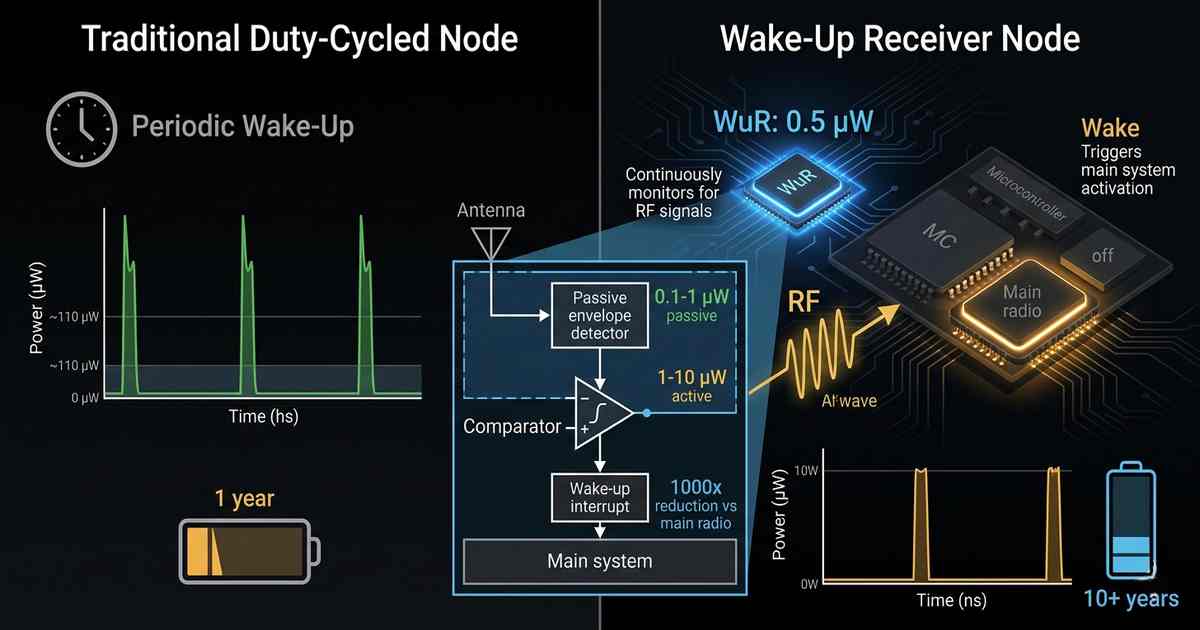
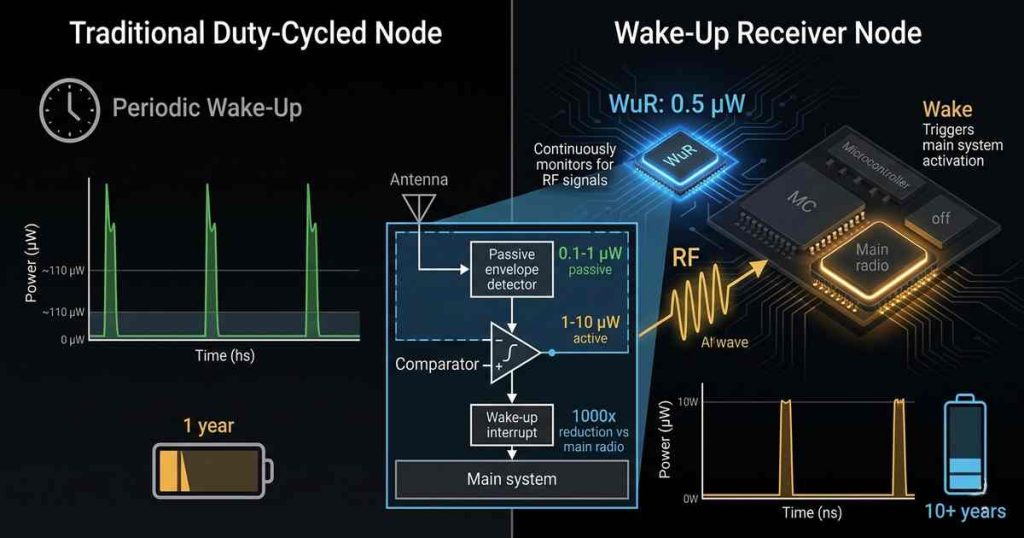
Conventional wireless sensor nodes operate on a periodic duty cycle. They wake every few seconds or minutes, sample sensors, process data, transmit, and return to sleep. Even with aggressive duty cycling (1% active, 99% sleep), a node consuming 10 mW active and 10 µW sleep averages 110 µW—draining a 1000 mAh battery in approximately one year.
The inefficiency comes from three sources:
Periodic sampling: Most sensor data contains no useful information. A temperature sensor sampling every minute generates 525,600 readings per year, of which perhaps 10 are meaningful events.
Idle listening: Radio receivers listening for commands consume milliwatts continuously, even when no data is transmitted.
Processing overhead: Microcontrollers must wake, initialize, execute code, and sleep—wasting energy on housekeeping rather than computation.
Wake-Up Receivers: The Ultra-Low-Power Listening Post
A wake-up receiver (WuR) is a secondary radio that listens continuously but consumes orders of magnitude less power than a main radio—typically 1-10 µW compared to 10-100 mW. WuRs cannot transmit data; they only detect specific wake-up patterns or tones. When a valid wake-up signal is detected, the WuR triggers the main system to power on, sample sensors, and transmit data.
How WuRs Work
The simplest WuRs use envelope detection: a passive antenna, a diode detector, and a comparator. Incoming RF energy is rectified and filtered; if the signal strength exceeds a threshold for a defined pattern, the comparator generates an interrupt. These passive WuRs consume 0.1-1 µW—enabling decade-long battery life.
More sophisticated WuRs use injection-locked oscillators or frequency-selective circuits to detect specific modulation patterns, reducing false wake-ups. Modern implementations integrate WuRs into the same silicon as the main radio, enabling single-chip solutions with <1 µW listening power.
Applications in Context
Medical implants: A continuous glucose monitor with WuR can remain asleep until a nearby reader activates it, preserving battery for years rather than months.
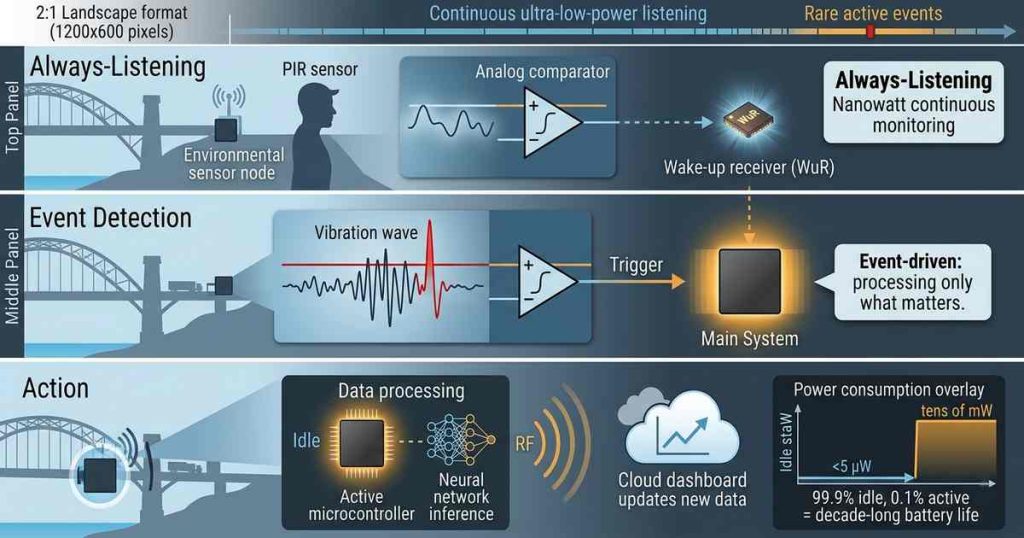
Structural monitoring: Bridge sensors with WuR sleep indefinitely until a vehicle crossing generates vibration exceeding a threshold, triggering data collection.
Smart homes: Occupancy sensors using WuR can operate for a decade on coin cells, enabling true “set and forget” deployments.
Event-Driven Computing: Processing Only What Matters
WuRs address the communication problem; event-driven computing addresses the processing problem. Instead of continuous or periodic sampling, event-driven systems use asynchronous circuits and near-threshold computing to process only meaningful events.
Analog Front-End Processing
The most efficient event detection occurs in the analog domain. An analog comparator monitoring a microphone consumes nanowatts—thousands of times less than digitizing and processing the signal. When the comparator detects acoustic energy above threshold, it triggers a wake-up; only then does the system digitize and classify.
This analog-first approach extends to multiple modalities. A passive infrared (PIR) sensor consumes 1-5 µW and detects human presence directly, without digital processing. A piezoelectric vibration sensor generates its own charge when movement occurs. By handling event detection in analog hardware, the digital system remains asleep until genuinely needed.
Asynchronous Digital Logic
Conventional microcontrollers use synchronous clocks; even when idle, clock distribution consumes power. Asynchronous (clockless) logic eliminates the clock, consuming power only when switching. Asynchronous circuits have near-zero static power and can respond to events without wake-up latency.
Commercial asynchronous processors like the ARM Cortex-M0+ with SleepWalker technology achieve active power as low as 10 µW/MHz and can wake from deep sleep in microseconds rather than milliseconds.
Near-Threshold Computing
Reducing supply voltage near the transistor threshold voltage dramatically reduces power consumption—but also reduces maximum frequency. For event-driven nodes that rarely compute, near-threshold operation is ideal: power scales quadratically with voltage, and latency is acceptable because events are infrequent.
Wake-Up Receiver Architectures: A Taxonomy
Passive WuRs
- Power consumption: 0.1-1 µW
- Complexity: Simple, discrete components
- Selectivity: Low (any RF energy may trigger)
- Applications: Very low-cost, low-duty-cycle nodes
Active WuRs
- Power consumption: 1-10 µW
- Complexity: Integrated CMOS design
- Selectivity: High (addressable, modulation-specific)
- Applications: Networks requiring selective waking
Dual-Radio WuRs
- Power consumption: 5-20 µW
- Complexity: WuR + main radio on same die
- Selectivity: Full protocol support
- Applications: Mainstream IoT devices
Event-Driven Sensor Node Architecture
A complete event-driven sensor node integrates:
WuR: Continuous listening at <1 µW, awaiting activation
Event sensors: Analog comparators, PIR, vibration sensors consuming 1-10 µW for continuous monitoring
Power management: Switches that disconnect main system power entirely until needed
Main microcontroller: Capable of 1-50 mW operation for short bursts
Radio: 10-100 mW during transmission, powered only after wake-up
When idle, total system power is 1-10 µW—enabling 10+ years on a 1000 mAh battery.
The Event-Driven Protocol Stack
Event-driven architectures require rethinking communication protocols:
Asynchronous MAC: Instead of scheduled wake-ups, nodes wake only when events occur or when addressed by WuR
Preamble sampling elimination: WuRs eliminate the need for long preambles that waste energy
Duty cycle elimination: Nodes never wake unless triggered, eliminating periodic wake-up overhead
Applications Transforming Industries
Wildlife tracking: Tags with WuR and event sensors can operate for 5-10 years, enabling migration studies impossible with battery-reliant tags.
Industrial predictive maintenance: Vibration sensors on motors sleep until anomaly detection triggers recording and transmission—capturing failure signatures without continuous monitoring.
Medical adherence monitoring: Pill bottle sensors with WuR report only when opened, operating for years without battery replacement.
Environmental monitoring: Remote soil moisture sensors wake only during rainfall events or when interrogated, enabling decade-long deployments.
Challenges and Limitations
False wake-ups: WuRs triggered by interference or noise cause unnecessary power consumption. Frequency selectivity and pattern matching reduce but cannot eliminate false triggers.
Latency: WuR-based systems have higher latency than always-on systems—typically milliseconds rather than microseconds. For many applications, this is acceptable.
Complexity: Integrating WuR and event-driven logic increases design complexity and bill of materials.
Network coordination: Event-driven nodes cannot synchronize with each other without periodic wake-ups, complicating mesh networking.
The Future: Ambient Energy Integration
The ultimate always-on sensor node combines WuR and event-driven computing with energy harvesting. When average power consumption falls below 10 µW, ambient energy—solar, thermal, RF, vibration—can power the node indefinitely without batteries.
Commercial energy harvesting PMICs now achieve 80-90% efficiency at input powers as low as 10 µW. Combined with WuRs consuming 1 µW and event-driven processing, truly perpetual sensor nodes are within reach.
Conclusion
Wake-up receivers and event-driven computing architectures represent a fundamental shift from scheduled to asynchronous sensing. By consuming nanowatts in standby and activating only for meaningful events, these systems enable sensor nodes that operate for years or decades on small batteries—or indefinitely on harvested energy.
The technology is maturing. Commercial WuR-integrated radios are available from multiple vendors. Asynchronous processors are entering mainstream MCUs. And the applications—from medical implants to industrial IoT to environmental monitoring—are demanding exactly these capabilities.
The future of sensing is not always-on. It is always-ready, always-listening, and only rarely active. And that is precisely how a trillion sensors will become possible.