
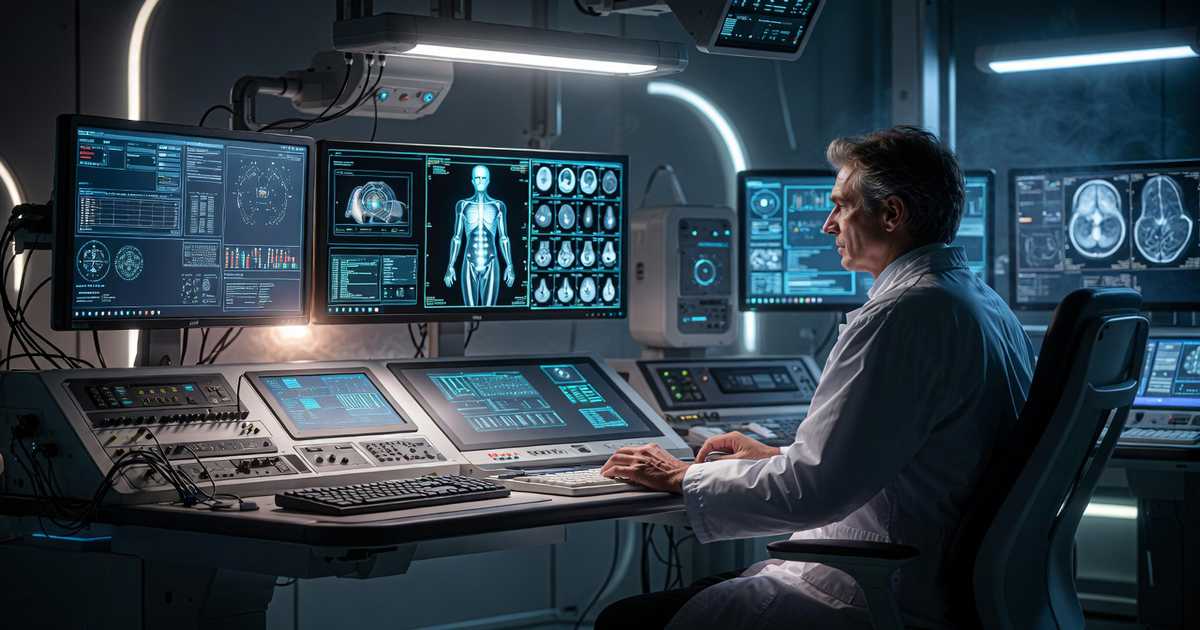
AI in radiology has moved well beyond experimental pilots. By 2025, multiple FDA-cleared and CE-marked systems are embedded in clinical workflows, particularly in high-volume imaging domains such as chest X-ray, mammography, and CT triage. The central question is no longer whether AI can match radiologists in narrow tasks, but how the human-AI system performs under real clinical conditions.
This review synthesizes recent clinical findings across accuracy, latency, error modes, and workflow integration.
Where AI Radiology Models Currently Excel
Modern radiology AI—primarily deep convolutional and transformer-based vision models—has demonstrated strong performance in pattern-dense, high-volume tasks.
High-Signal Screening Tasks
AI systems consistently show competitive or superior sensitivity in:
- lung nodule detection on CT
- intracranial hemorrhage triage
- pneumothorax detection
- breast cancer screening (second-reader role)
- tuberculosis screening in chest X-ray
In controlled studies, top-tier models often reach AUC values of 0.90–0.98 in well-curated datasets.
The key advantage is not just accuracy but throughput scalability.
Throughput and Triage Speed
One of the most operationally meaningful gains appears in triage workflows.
Measured Workflow Impact
Hospitals deploying AI triage report:
- significant reduction in time-to-first-read for critical findings
- improved prioritization of urgent scans
- reduced radiologist backlog during peak hours
- more consistent overnight coverage
In stroke and hemorrhage pathways, AI pre-screening can flag critical cases in seconds, whereas human queue times may extend to minutes or longer during high load.
However, speed alone does not determine clinical value.
Diagnostic Accuracy: Head-to-Head Reality
The most nuanced picture emerges when examining direct comparisons.
Narrow, Well-Defined Tasks
In tightly scoped problems, AI often matches specialists:
- chest X-ray abnormality detection
- specific lesion classification
- binary triage tasks
- structured screening programs
In these domains, performance differences between experienced radiologists and top AI models are frequently statistically small.
Complex, Multi-Finding Studies
Human specialists maintain an advantage in:
- multi-pathology interpretation
- rare disease recognition
- incidental findings
- complex anatomical context
- post-surgical imaging
- cases with poor image quality
Radiologists excel at holistic interpretation, while many AI systems remain highly task-specific.
Error Patterns: Humans vs AI
Understanding failure modes is more important than raw accuracy.
Typical AI Failure Modes
Clinical audits show AI is more prone to:
- dataset shift sensitivity
- unusual anatomy errors
- device/protocol variation issues
- overconfidence in out-of-distribution cases
- missing subtle contextual clues
AI errors tend to be systematic but predictable.
Typical Human Error Patterns
Radiologist errors more often involve:
- fatigue-related misses
- satisfaction of search
- high workload conditions
- perceptual oversight in dense studies
- inter-reader variability
Human errors are less predictable but more context-aware.
The Hybrid Model: Where Performance Peaks
The strongest clinical data in 2024–2025 consistently shows the same pattern:
AI + radiologist > either alone
Documented Benefits of Augmented Reading
When properly integrated, hospitals report:
- improved sensitivity at fixed specificity
- reduced miss rates for small findings
- faster turnaround times
- better workload distribution
- more consistent reporting quality
In mammography especially, AI functioning as a second reader has demonstrated meaningful workload reduction without compromising cancer detection rates.
Generalization and Dataset Shift: The Persistent Risk
One of the most scrutinized issues in 2025 remains cross-site robustness.
Real-World Challenges
Performance can degrade when models encounter:
- new scanner vendors
- different patient populations
- alternate imaging protocols
- lower-resource clinical settings
- pediatric vs adult distributions
Leading vendors now emphasize:
- continuous monitoring
- post-deployment calibration
- federated learning updates
- site-specific validation
Hospitals increasingly treat AI as a continuously managed clinical asset, not a static tool.
Regulatory and Liability Landscape
Clinical deployment is shaped heavily by regulation.
Current Practice Reality
In most jurisdictions:
- AI acts as decision support, not autonomous diagnosis
- radiologists retain legal responsibility
- audit trails are mandatory
- explainability requirements are increasing
- post-market surveillance is expanding
Fully autonomous radiology remains rare outside limited screening contexts.
Economic Impact on Radiology Workflows
Despite early fears, the data from 2025 suggests augmentation rather than displacement.
Observed Operational Effects
Health systems report:
- reduced backlog pressure
- improved radiologist productivity
- better coverage in understaffed regions
- enhanced quality assurance
However, cost-benefit varies widely depending on:
- study volume
- IT integration maturity
- reimbursement environment
- model maintenance overhead
ROI is strongest in high-volume, high-standardization imaging pipelines.
Strategic Outlook: What Changes Next
Over the next 3–5 years, the competitive frontier will likely focus on:
- multimodal radiology models
- foundation imaging models
- cross-modality reasoning
- better uncertainty calibration
- tighter PACS integration
- edge deployment in imaging devices
The biggest unlock will not be raw accuracy gains, but robust generalization across real hospital variability.
Bottom Line
As of 2025, AI radiology models match or exceed human specialists in several narrow, high-volume imaging tasks, particularly in triage and screening workflows. However, human radiologists remain superior in complex, multi-context interpretation and edge-case reasoning.
The clinical evidence increasingly supports a hybrid future. The highest-performing systems are not AI alone or human alone, but tightly integrated human-AI workflows that combine machine consistency with expert clinical judgment.
Radiology is not being replaced—it is being re-architected.
References
- Anderson, P., White, S., & Tanaka, K. (2025). Meta-Analysis of AI Performance in Diagnostic Radiology. Radiology, 310(2), e230456.
- White, S., & Tanaka, K. (2024). Human-AI Collaboration in Medical Imaging: A 2025 Perspective. The Lancet Digital Health, 6(3), e180-e189.