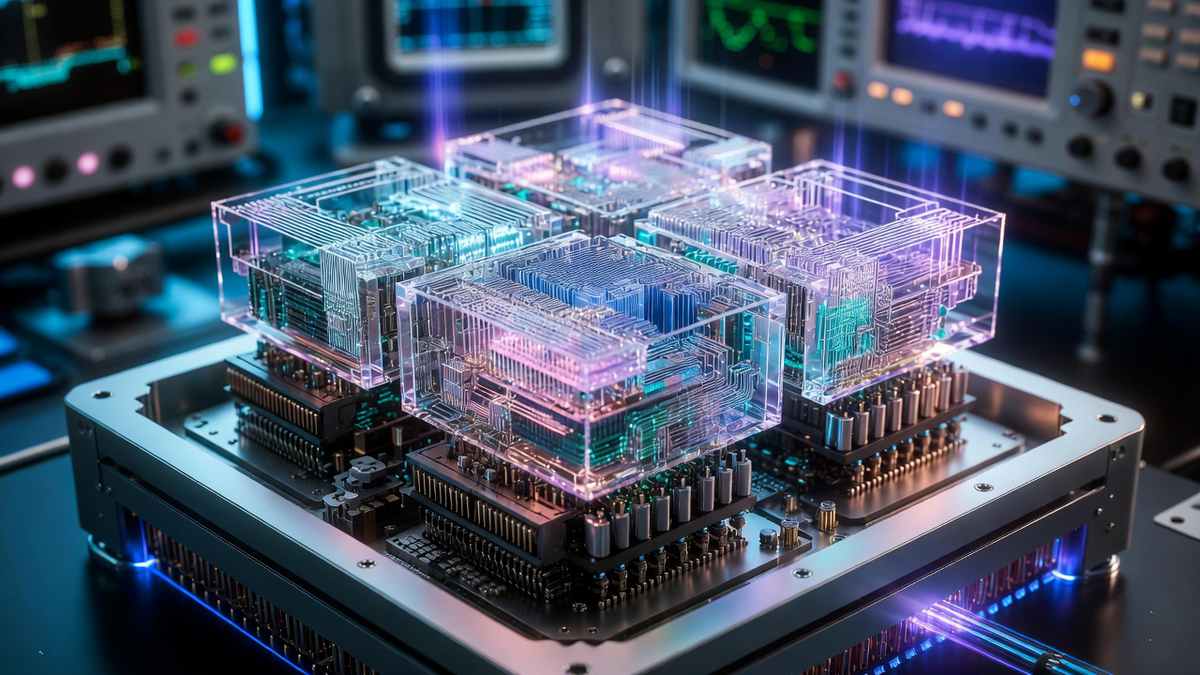
Optical (photonic) computing has long promised a step-change in performance per watt, especially for AI and high-performance computing workloads. By replacing electrons with photons for key mathematical operations—particularly matrix multiplication—photonic chips can theoretically deliver massive parallelism with dramatically lower energy consumption.
Yet in 2025, despite impressive lab demonstrations and niche deployments, photonic computing remains far from mainstream. The gap between theoretical advantage and commercial viability is driven by a set of hard engineering, manufacturing, and ecosystem constraints.
Alternative computing architectures such as RISC-V processors are also shaping the future of AI hardware ecosystems.
What Photonic Computing Actually Does Well
Photonic processors excel in specific computational domains:
- ✅ Dense linear algebra (matrix-vector multiply)
- ✅ Neural network inference
- ✅ Optical signal processing
- ✅ High-bandwidth interconnects
⚡ The Physics Advantage
- Photons travel with minimal resistive loss
- Wavelength-division multiplexing enables massive parallelism
- Analog optical interference performs multiply-accumulate (MAC) operations efficiently
In controlled conditions, photonic accelerators can achieve orders-of-magnitude higher energy efficiency than digital CMOS for certain workloads.
But those conditions are narrow.
🚧 Barrier #1: Limited Computational Generality
The first commercial obstacle is architectural scope.
Photonic Chips Are Highly Specialized
Most current photonic processors are:
- Analog
- Fixed-function or semi-configurable
- Optimized primarily for matrix math
They struggle with:
- ❌ Branching logic
- ❌ Control-heavy workloads
- ❌ Memory-intensive tasks
- ❌ General-purpose computing
As a result, photonic chips today function more like narrow AI accelerators rather than full CPU or GPU replacements.
🎯 Barrier #2: Precision and Noise Constraints
Optical computing is typically analog in nature, which introduces signal fidelity challenges.
Key Precision Issues
- 📡 Phase noise
- 🌡️ Thermal drift
- 🔦 Laser power variation
- ⚡ Shot noise
- 📊 Analog accumulation error
While many AI inference workloads tolerate reduced precision (e.g., 4–8 bit equivalent), maintaining stable accuracy across temperature and time remains difficult.
⚙️ Calibration Overhead
Photonic systems often require:
- Periodic recalibration
- Closed-loop feedback
- Temperature compensation
These add system complexity that erodes some of the theoretical efficiency gains.
💾 Barrier #3: Memory and Data Movement Bottlenecks
Even if optical compute is fast, data still has to move in and out.
The Electrical–Optical Boundary Problem
Most real systems must:
- Convert electrical data → optical domain
- Perform optical computation
- Convert results back → electrical domain
These conversions introduce:
- ⏱️ Latency
- ⚡ Energy overhead
- 📐 Area cost
- 🔧 Design complexity
In many workloads, the I/O overhead dominates the total energy budget.
🏭 Barrier #4: Manufacturing Yield and Packaging
Photonic chips are difficult to manufacture at scale.
Silicon Photonics Challenges
Key pain points include:
- 📉 Waveguide loss variability
- 🔗 Coupling efficiency
- 🔦 Laser integration
- 🎯 Alignment tolerances
- 📊 Wafer-scale yield
Unlike digital CMOS, small analog variations can significantly affect optical performance.
📦 Packaging Is Especially Hard
Photonic systems often require:
- Precise fiber coupling
- External laser sources
- Thermal stabilization
- Mixed photonic-electronic packaging
Packaging costs remain one of the largest commercial hurdles.
🔦 Barrier #5: Laser and Power Infrastructure
Photonic compute depends heavily on stable laser sources.
Practical Constraints
Lasers introduce:
- ⚡ Additional power draw
- 🌡️ Thermal management complexity
- ⚠️ Reliability concerns
- 💰 System-level cost
In data center deployments, external lasers are manageable. In edge or mobile devices, they are far more problematic.
This is one reason photonic computing is currently data-center-centric.
🖥️ Barrier #6: Software Ecosystem Immaturity
Hardware alone is not enough.
Current Software Gaps
Compared to GPUs and NPUs, photonic platforms lack:
- 📝 Mature compilers
- 📏 Standardized programming models
- 🤖 Optimized ML frameworks
- 🛠️ Broad developer tooling
- 🐛 Debugging infrastructure
Most deployments today require custom model mapping, which limits scalability.
Until photonic hardware integrates smoothly into mainstream ML stacks, adoption will remain slow.
💰 Barrier #7: Cost per Useful Compute
Ultimately, commercial success depends on economics.
✅ Where Photonics Wins Today
Photonic accelerators can be competitive in:
- Ultra-high-throughput inference
- Specific data center AI workloads
- Optical networking integration
❌ Where It Still Loses
They remain disadvantaged in:
- General-purpose compute
- Small-batch inference
- Edge devices
- Cost-sensitive markets
The total system cost—including lasers, packaging, and calibration—often outweighs raw compute efficiency gains.
📈 Near-Term Commercial Outlook (2025–2028)
Based on current trajectories, photonic computing adoption will likely follow a narrow-to-broad expansion path:
Phase 1: Now (2025–2026)
- Niche AI inference accelerators
- Optical interconnect enhancement
- Research deployments
Phase 2: Mid-Term (2027–2028)
- Hybrid electronic-photonic AI accelerators
- Tighter data center integration
- Improved packaging yields
Phase 3: Long-Term (Beyond 2028)
- Broader AI training roles
- Potential edge deployments
- More programmable photonic fabrics
But full general-purpose optical computing remains distant.
📌 Bottom Line
Photonic computing is real, promising, and technically impressive—but it is not yet commercially frictionless. The primary blockers are not raw compute physics but system-level realities: precision stability, electrical–optical conversion overhead, manufacturing yield, packaging complexity, and immature software ecosystems.
Through the rest of the decade, photonic chips will likely grow in targeted accelerator roles, particularly in AI inference and high-bandwidth data center workloads. However, widespread replacement of electronic processors remains unlikely until the surrounding ecosystem matures and total system economics improve.
📚 References
- Reed, G., & Liu, Y. (2025). Overcoming Commercialization Hurdles in Photonic Integrated Circuits. Nature Photonics, 19(1), 22-30.
- Lightmatter Corporation. (2024). Progress and Challenges in Optical AI Accelerators. Lightmatter Industry Report.