
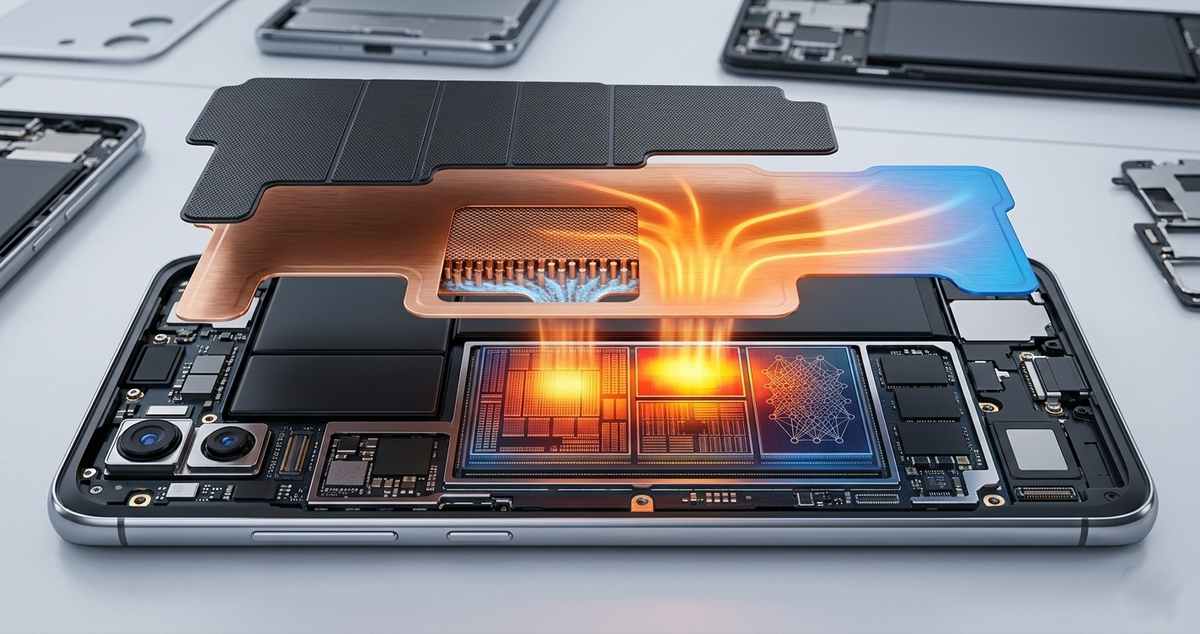
As mobile SoCs become more powerful, integrating dedicated NPUs, high-frequency CPUs, and multi-core GPUs, thermal management has become a critical design challenge. Flagship smartphones in 2025 routinely push sustained workloads such as AI inference, 3D gaming, and real-time video processing. Without effective cooling, these workloads trigger thermal throttling, reducing performance and user experience.
As AI workloads increase on smartphones, the efficiency of On-device neural processing units becomes an important factor in thermal management.
Vapor chamber cooling has emerged as the most effective solution for maintaining high performance in a compact mobile form factor. This article explores the technology, implementation strategies, and real-world impact on flagship SoCs.
How Vapor Chamber Cooling Works
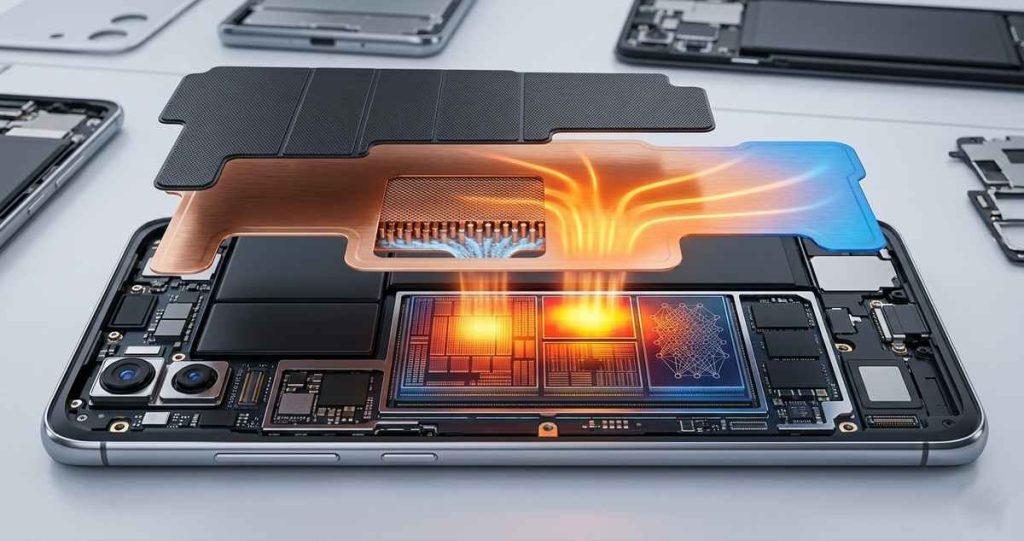
A vapor chamber is essentially a heat spreader with phase-change properties.
Key Components
- Enclosure: sealed chamber made of copper or copper alloy
- Working fluid: small amount of liquid that vaporizes when heated
- Wick structure: capillary network that returns condensed liquid to the heat source
- Heat sink interface: transfers heat to chassis or additional thermal layers
Heat Transfer Process
- Heat from the SoC evaporates the liquid at the hot spot.
- Vapor spreads rapidly across the chamber.
- Vapor condenses at cooler areas of the chamber.
- Capillary action returns liquid to the hot spot.
This phase-change mechanism provides extremely high effective thermal conductivity, far exceeding solid metal spreaders.
Why Flagship Mobile SoCs Require Advanced Cooling
1. High Power Density
Modern SoCs integrate:
- octa-core CPUs with high-performance and efficiency cores
- AI NPUs performing trillions of operations per second
- GPUs for gaming and AR workloads
Power densities can exceed 15–20 W/cm², far higher than early smartphone chips.
2. Sustained Workload Performance
Without effective cooling:
- CPU/GPU/NPU frequency must be throttled
- AI model inference times increase
- Gaming frame rates drop
- Thermal hotspots can damage components
Vapor chambers allow long-duration performance at peak frequencies.
3. Compact Form Factor
Mobile devices demand thin and light designs, leaving little room for traditional heatsinks or active cooling. Vapor chambers maximize heat spreading without adding bulk.
Real-World Implementation in 2025 Flagships
Typical Vapor Chamber Design
- thin copper sheet (0.2–0.5 mm)
- integrated with graphite heat spreaders
- connected to frame or midplate for heat dissipation
- sometimes combined with phase-change polymer layers for additional thermal smoothing
Performance Metrics
- reduces hotspot temperature by 5–15°C under sustained load
- improves AI NPU throughput by 10–20% in prolonged tasks
- stabilizes gaming frame rates over long sessions
- lowers surface temperatures for user comfort
Integration Challenges
- precision soldering and bonding
- maintaining flatness and uniform contact
- balancing thickness with chassis rigidity
- ensuring long-term reliability under thermal cycling
Interaction with AI and GPU Workloads
Vapor chamber cooling has become essential for AI-heavy smartphones:
- Edge AI inference:
- Sustained matrix operations generate hotspots on NPU cores.
- Vapor chamber spreads heat evenly, preventing frequency drop.
- Real-time AR/ML pipelines:
- Camera + neural processing pipelines produce localized heating.
- Phase-change cooling ensures consistent performance.
- Gaming and graphics:
- High frame-rate rendering on GPU cores generates peak power bursts.
- Vapor chambers maintain thermal stability over long sessions.
Comparison with Alternative Cooling Methods
| Cooling Method | Pros | Cons |
|---|---|---|
| Copper Heat Spreader | Simple, cheap | Limited spreading, prone to hotspots |
| Graphite Sheet | Ultra-thin, flexible | Lower thermal conductivity than vapor |
| Vapor Chamber | High thermal conductivity, spreads heat | More complex, higher cost, precision needed |
| Active Cooling (Fan) | Extremely effective | Not viable in thin smartphones |
Vapor chambers hit the sweet spot for thin, high-performance mobile devices.
Limitations and Future Directions
- Manufacturing cost: vapor chambers are more expensive than graphite layers.
- Thickness constraints: ultra-thin devices still limit chamber size.
- Material fatigue: repeated thermal cycling can affect longevity.
- Hybrid cooling: some manufacturers experiment with mini heat pipes, vapor chamber + graphene, or polymer composites.
Future mobile SoCs may leverage AI-driven thermal management, dynamically redirecting workloads based on predicted hotspot formation to maximize vapor chamber efficiency.
Bottom Line
Advanced vapor chamber cooling is no longer optional for flagship smartphones in 2025. It enables sustained AI, GPU, and CPU workloads in compact form factors, reduces thermal throttling, and enhances user experience during extended usage. While manufacturing complexity and cost remain challenges, vapor chambers represent the most effective passive thermal solution currently available for high-density mobile SoCs.
References
- Wilson, G. (2025). Thermal Management Solutions for 2025 Flagship Mobile Processors. IEEE Transactions on Components, Packaging and Manufacturing Technology, 15(2), 210-220.
- Xiaomi Technologies. (2024). Innovations in Vapor Chamber Cooling for the Mi 15 Series. Xiaomi Engineering Report.