
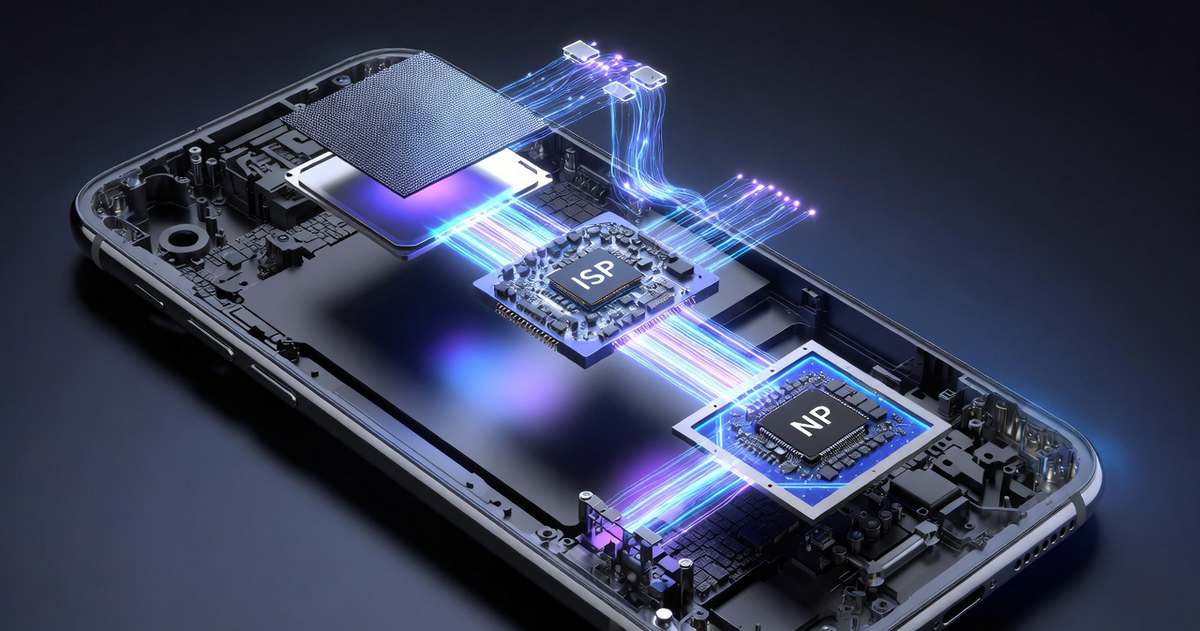
By 2025, smartphone camera performance is determined less by raw sensor specifications and more by the sophistication of the AI-augmented Image Signal Processor (ISP) pipeline. Modern flagships execute a tightly orchestrated sequence of classical image processing and neural inference steps between photon capture and final image output.
The competitive edge now lies in how efficiently vendors fuse traditional ISP blocks with machine learning models across the entire imaging chain. This article breaks down the real architecture used in current-generation devices and explains where AI is delivering measurable gains.
The Modern Smartphone Imaging Stack
A contemporary mobile imaging pipeline typically consists of:
- Sensor capture
- RAW-domain preprocessing
- Classical ISP stages
- AI enhancement modules
- Multi-frame computational fusion
- Tone mapping and color science
- Final rendering and compression
The defining shift in 2025 is that AI is deeply embedded across multiple stages, not merely applied as a cosmetic post-processing layer.
Stage 1: Sensor Capture and RAW-Domain Conditioning
Image formation begins at the CMOS sensor, which outputs high–bit depth Bayer (or equivalent) RAW data. At this stage, the signal is still:
- noisy in low light
- optically distorted
- affected by sensor non-uniformities
- susceptible to rolling shutter artifacts
Emerging AI Roles in the RAW Domain
Leading smartphone platforms now introduce lightweight neural networks early in the pipeline to perform:
- RAW denoising
- defective pixel correction
- lens shading estimation
- early exposure guidance
- rolling shutter mitigation
Operating in the RAW domain preserves maximum information and gives downstream stages cleaner input. However, strict latency and power budgets mean models here must be extremely compact and hardware-optimized.
Stage 2: AI-Guided Exposure Planning and HDR Fusion
High dynamic range capture has evolved from simple frame stacking into a semantically aware fusion problem.
Modern Multi-Frame Capture
Typical 2025 capture pipelines may collect:
- multiple short exposures
- one or more mid exposures
- long exposures for shadow recovery
- motion reference frames
AI models analyze the burst to perform:
- motion segmentation
- ghost artifact suppression
- exposure weighting
- face and skin protection
- sky and highlight preservation
The key innovation is that HDR decisions are now content-aware, not purely histogram-driven.
Stage 3: AI-Assisted Demosaicing
Demosaicing converts Bayer-pattern RAW data into full RGB pixels. Classical algorithms relied on edge-aware interpolation, which often introduced:
- zipper artifacts
- color moiré
- texture smearing
What AI Improves
Neural demosaicing models can better reconstruct:
- fine repetitive textures
- hair and fabric detail
- diagonal edges
- low-light color fidelity
In practice, most 2025 smartphones use hybrid pipelines where AI assists rather than fully replaces traditional demosaicing due to compute constraints.
Stage 4: Multi-Frame Noise Reduction (MFNR)
Noise reduction remains one of the largest image quality differentiators.
The Shift to AI Temporal Denoising
Modern pipelines combine:
- temporal stacking
- motion compensation
- neural denoising networks
AI helps the system distinguish between:
- true image detail
- random photon noise
- motion blur
- compression artifacts
Well-tuned systems preserve micro-texture while aggressively cleaning shadow regions — something classical spatial filters struggled to achieve simultaneously.
Stage 5: Semantic Scene Understanding
One of the most consequential 2025 upgrades is real-time scene segmentation embedded in the ISP flow.
What the Scene Model Detects
Typical on-device vision models classify regions such as:
- faces and skin
- sky
- foliage
- text
- food
- night scenes
- backlit subjects
Why This Matters
Semantic awareness enables localized processing, including:
- region-specific sharpening
- selective noise reduction
- adaptive tone curves
- skin tone protection
- sky color preservation
This is a primary reason modern smartphone photos appear more “intentionally processed” than earlier computational photography generations.
Stage 6: AI-Enhanced Tone Mapping and Color Science
Tone mapping converts the high dynamic range internal image into a display-ready output.
Classical vs AI Tone Mapping
Traditional pipelines relied on global curves. Modern systems incorporate neural assistance to achieve:
- local contrast enhancement
- highlight roll-off control
- shadow lifting without washout
- perceptual brightness optimization
AI also contributes to auto white balance (AWB) and color constancy, especially under mixed lighting where rule-based systems historically struggled.
Stage 7: Super Resolution and Detail Enhancement
Many 2025 devices apply AI upscaling or detail recovery, particularly in:
- digital zoom
- night mode
- small-sensor telephoto
- video frame enhancement
These models reconstruct plausible high-frequency detail using learned priors. The best implementations balance perceived sharpness without introducing synthetic-looking artifacts.
Hardware Acceleration: ISP, GPU, and NPU Cooperation
Modern smartphone imaging is a heterogeneous compute problem.
Typical Workload Partitioning
- ISP: deterministic pixel pipeline, low-latency stages
- NPU: neural inference (denoise, segmentation, HDR guidance)
- GPU: heavy parallel bursts (fusion, super-resolution)
- CPU: orchestration and control logic
Efficient scheduling between these blocks is now a key competitive differentiator. Poor pipeline balancing can lead to shutter lag, overheating, or battery drain.
Power and Latency Constraints
Unlike cloud imaging, mobile pipelines must operate under strict budgets:
- capture-to-preview latency targets
- thermal limits in thin devices
- battery consumption ceilings
- real-time video requirements
As a result, many AI models in smartphones are:
- heavily quantized (INT8/INT4)
- tile-based
- sparsity-optimized
- fused with classical operators
The engineering challenge is delivering visible gains within milliwatt-scale envelopes.
What Actually Improves Photo Quality in 2025
Based on real device analysis, the most impactful AI ISP upgrades are:
- better low-light noise handling
- more natural HDR
- improved skin tone rendering
- stronger digital zoom
- reduced motion ghosting
- smarter scene-adaptive processing
Megapixel increases alone now deliver diminishing returns compared to pipeline intelligence.
Strategic Outlook
Through the next hardware cycles, expect continued movement toward:
- fully neural ISP blocks
- larger on-device vision models
- tighter NPU–ISP coupling
- RAW-domain AI expansion
- video-first AI pipelines
- personalized imaging profiles
The long-term trajectory is clear: smartphone cameras are becoming real-time computational imaging systems rather than simple optical capture devices.
Bottom Line
In 2025, the quality of a smartphone camera is primarily determined by the sophistication of its AI ISP pipeline. Neural models now influence nearly every stage from RAW capture to final rendering, enabling major gains in low-light performance, HDR realism, and semantic image tuning.
The next wave of differentiation will not come from bigger sensors alone, but from deeper integration between ISP hardware, NPUs, and AI-driven computational photography stacks.