
The Mobile Gaming Crossroads
Mobile gaming has surpassed every other gaming segment combined. With over 2.5 billion players worldwide and revenues exceeding $100 billion annually, it is no longer a secondary platform but the dominant force in interactive entertainment. Yet mobile gaming faces a fundamental tension: the demand for console-quality visuals and immersive experiences is colliding with the physical constraints of pocket-sized devices.
The solution space has bifurcated into two competing paradigms. Cloud offloading—streaming games rendered on remote servers to mobile devices—promises unlimited graphical fidelity unconstrained by local hardware. Local GPU rendering leverages increasingly powerful mobile silicon to deliver native experiences without network dependency. The choice between them involves complex trade-offs across latency, visual quality, power consumption, and user experience.
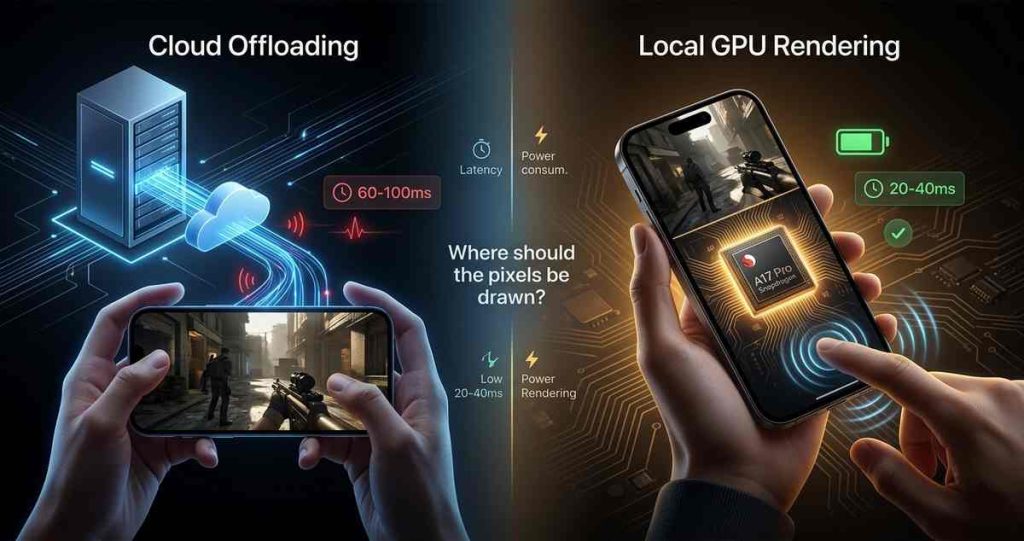
This is the edge rendering challenge: where should the pixels be drawn?
The Case for Local GPU Rendering
The Evolution of Mobile Silicon
Mobile GPUs have undergone a revolution. Apple’s A17 Pro, Qualcomm’s Snapdragon 8 Gen 3, and MediaTek’s Dimensity 9300 deliver performance that rivals last-generation gaming consoles and low-end desktop GPUs. The numbers are striking:
- Apple A17 Pro: 6-core GPU with hardware-accelerated ray tracing, mesh shading, and dynamic caching. Sustained performance exceeding 2 TFLOPS.
- Snapdragon 8 Gen 3: Adreno 750 GPU with 25% faster rendering and 25% improved power efficiency over previous generation. Hardware-accelerated ray tracing and Unreal Engine 5.3 optimizations.
- Dimensity 9300: Immortalis-G720 GPU with 12 cores, 46% improved performance, and second-generation hardware ray tracing.
These aren’t incremental improvements. Modern flagship smartphones can run console-quality titles like Resident Evil Village, Assassin’s Creed Mirage, and Death Stranding at playable frame rates—titles that would have required a dedicated gaming PC a decade ago.
The Latency Advantage
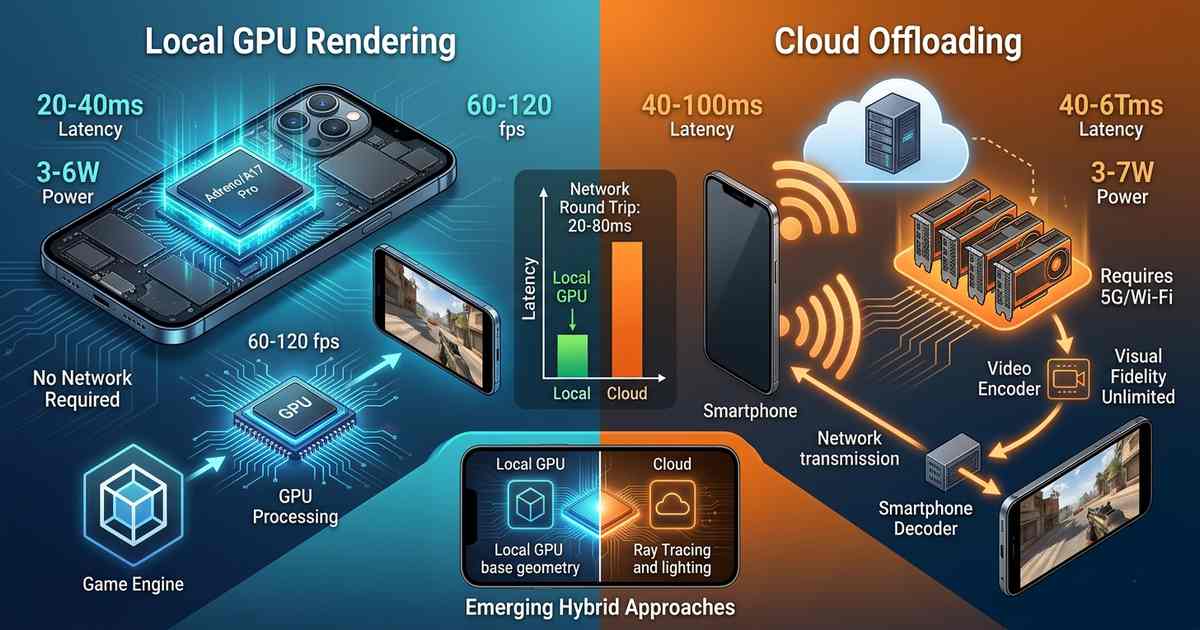
Latency is the unbreakable advantage of local rendering. From touch input to pixel update, a locally rendered game completes the loop in 30-60 milliseconds on modern hardware. Input latency breaks down as:
- Touch sensor processing: 5-10 ms
- Game engine processing: 10-20 ms
- GPU rendering: 8-16 ms (60 fps)
- Display refresh: 8-16 ms
Total: 31-62 ms. At 120 fps on high-refresh-rate displays, total latency drops to 20-40 ms—indistinguishable from instantaneous for most players.
This matters. In competitive gaming, latency differences of 50-100 milliseconds separate victory from defeat. Even in casual gaming, latency above 100 milliseconds creates perceptible “sluggishness” that breaks immersion. Local rendering delivers the lowest possible latency by eliminating the network round trip entirely.
Power Efficiency and Battery Life
Counterintuitively, local rendering can be more power-efficient than cloud streaming for sustained gaming sessions. A modern mobile GPU rendering a game at 60 fps consumes 3-6 watts of system power. Cloud streaming requires:
- Network radio active (5G/Wi-Fi): 1-2 watts
- Video decoding hardware: 0.5-1 watt
- Display backlight: 1-2 watts
- System overhead: 1-2 watts
Total: 3.5-7 watts—comparable to or exceeding local rendering, with the added caveat that streaming requires continuous network activity, which drains battery even when the screen is off during streaming pauses.
No Network Dependency
Local rendering works anywhere, anytime. On an airplane, in a subway tunnel, during network congestion—the game runs regardless of connectivity. This reliability is essential for mobile gaming’s core value proposition: entertainment available wherever the user goes.
The Case for Cloud Offloading
Unlimited Graphical Fidelity
Cloud offloading decouples visual quality from device capability. A game rendered on an NVIDIA H100 or AMD Instinct MI300 in a data center can leverage ray tracing, path tracing, 4K resolution, and ultra-high-fidelity assets that no mobile chip can approach. The server GPU draws hundreds of watts; the mobile device simply decodes video.
This enables experiences impossible on local hardware. Cyberpunk 2077 with path tracing, Alan Wake 2 with full ray tracing, Microsoft Flight Simulator with photorealistic global terrain—these titles run on cloud gaming platforms at visual settings that would melt a smartphone.
Thermal Constraints Eliminated
Mobile devices are thermally constrained by physics. Sustained GPU load generates heat that must be dissipated through a surface area measured in square centimeters. Even the most powerful mobile chips throttle under extended load, reducing performance after 10-30 minutes of continuous gaming.
Cloud offloading eliminates thermal throttling. The rendering hardware resides in climate-controlled data centers. The mobile device’s only thermal load is video decoding—a fraction of the heat generated by native rendering. This enables consistent performance across gaming sessions of any duration.
Device Longevity and Accessibility
Cloud gaming democratizes high-end gaming. A budget smartphone with a 5G connection can play the same titles as a flagship device. Users need not upgrade hardware to access new graphical capabilities—the rendering infrastructure improves independently of client devices.
For developers, cloud offloading simplifies optimization. Rather than targeting dozens of mobile GPU variants with varying capabilities, developers target server-class hardware with consistent performance profiles. This reduces development costs and enables faster iteration.
Storage and Download Elimination
Mobile games have ballooned in size. Genshin Impact exceeds 30GB. Call of Duty: Mobile approaches 25GB. On devices with 128GB of storage, a handful of games consume available capacity. Cloud gaming eliminates downloads entirely. Players launch games instantly without installation, patching, or storage management.
The Critical Trade-Offs
Latency: The Unavoidable Network Delay
Latency is cloud gaming’s fundamental challenge. Every frame must travel from server to client, introducing unavoidable delay. The physics of fiber optics and packet switching impose minimum latencies:
- Server processing (game logic + rendering): 10-30 ms
- Video encoding: 5-15 ms
- Network transmission (round trip): 20-80 ms (depending on distance and infrastructure)
- Client decoding: 3-10 ms
- Display processing: 5-10 ms
Total: 43-145 ms—substantially higher than local rendering’s 30-60 ms. At the low end (43 ms), latency is noticeable but acceptable for many game genres. At the high end (145 ms), gameplay becomes frustrating, particularly in fast-paced titles.
The distance to edge infrastructure matters enormously. Users within 50 miles of a cloud gaming data center experience dramatically lower latency than those in rural areas or regions without local edge nodes. GeForce NOW, Xbox Cloud Gaming, and PlayStation Plus Premium have invested heavily in edge infrastructure, but coverage remains uneven globally.
Visual Quality: Compression Artifacts
Even with ideal latency, cloud gaming faces visual quality degradation. Video compression—necessary to transmit frames within bandwidth constraints—introduces artifacts that degrade image quality. Dark scenes exhibit blocking. Fast motion shows smearing. Text becomes less crisp.
Modern codecs (H.265, AV1) minimize these artifacts, but they cannot eliminate them entirely. A native 1080p render on local hardware looks sharper than a 4K render compressed to 20-40 Mbps streaming. For players who value visual fidelity, this compression penalty is significant.
Bandwidth and Data Caps
Cloud gaming consumes substantial bandwidth. At 1080p/60fps, streaming requires 10-20 Mbps. At 4K/60fps, 25-50 Mbps. A single hour of 4K cloud gaming consumes 11-22 GB of data. For users with cellular data caps or metered home internet connections, this is prohibitive.
Even on unmetered connections, bandwidth competition with other household activities (streaming video, video calls, file downloads) can degrade gaming quality. Network congestion during peak hours introduces packet loss and jitter, causing stuttering and resolution drops.
Input Lag Variability
Cloud gaming introduces variable input lag—the time between pressing a button and seeing the response. Unlike local rendering’s consistent latency, cloud latency varies with network conditions. This variability is more disruptive than constant latency. Players cannot develop muscle memory when response times fluctuate unpredictably.
Modern cloud platforms attempt to mitigate this through techniques like input prediction (anticipating player actions) and asynchronous timewarp (synthesizing intermediate frames), but these are partial solutions. For competitive gaming, variability remains a fundamental limitation.
Hybrid Approaches: The Best of Both Worlds
The industry is increasingly recognizing that binary choice—local or cloud—misses more nuanced solutions. Hybrid architectures are emerging that combine local rendering with cloud offloading.
Split Rendering
Split rendering distributes rendering workloads between device and cloud. The cloud handles compute-intensive effects (ray tracing, global illumination) while the device renders base geometry and handles input. The cloud transmits only lighting data or other high-level scene information, dramatically reducing bandwidth compared to full video streaming.
NVIDIA’s Cloud XR and Unreal Engine’s Pixel Streaming implement variants of split rendering, though widespread mobile adoption remains nascent.
Asset Streaming
Rather than streaming rendered frames, some platforms stream game assets—textures, models, audio—on demand. The local GPU renders the scene using assets streamed from the cloud. This reduces local storage requirements while maintaining local rendering’s latency advantages.
Microsoft’s DirectStorage technology, now coming to mobile, enables efficient asset streaming from cloud to local storage, reducing the storage burden of large games without sacrificing native performance.
Adaptive Hybrid Rendering
The most sophisticated hybrid systems adapt to network conditions. When network latency is low, they offload more rendering to the cloud, maximizing visual quality. When latency increases or connectivity degrades, they shift rendering to local GPU, maintaining responsiveness at the cost of reduced visual fidelity.
This approach requires both powerful local GPUs and robust cloud infrastructure—but it delivers the optimal experience across varying network conditions.
Real-World Platform Performance
NVIDIA GeForce NOW
NVIDIA’s cloud gaming platform leverages the company’s GPU expertise and extensive edge infrastructure. GeForce NOW Ultimate tier offers RTX 4080-class rendering with 240 fps support. Measured latency from edge nodes:
- Latency to nearest data center: 15-30 ms
- Total end-to-end latency: 40-70 ms
- Resolution up to 4K HDR at 60 fps or 1440p at 120 fps
GeForce NOW excels at delivering high-fidelity PC gaming to mobile devices, particularly when users are within range of NVIDIA’s edge network.
Xbox Cloud Gaming (xCloud)
Microsoft’s platform leverages Azure’s global infrastructure. Performance characteristics:
- Latency: 50-100 ms typical
- Resolution: Up to 1080p at 60 fps
- Integration with Xbox Game Pass Ultimate
Microsoft emphasizes library depth over pure latency performance, offering hundreds of games through a subscription model.
Apple’s Local-First Approach
Apple has doubled down on local rendering. The A17 Pro and M-series chips deliver console-class GPU performance. Metal 3 introduces features like MetalFX Upscaling (similar to DLSS/FSR) and fast resource loading that optimize local rendering. Apple’s strategy assumes that mobile GPUs will eventually match console capabilities—a bet that appears increasingly prescient.
Qualcomm’s Snapdragon G Series
Qualcomm’s dedicated gaming platforms (G1, G2, G3) target handheld gaming devices with enhanced GPU performance and thermal design. The G3x Gen 2 platform delivers sustained performance exceeding 2 TFLOPS, specifically optimized for extended gaming sessions.
The Power Dimension
Power consumption analysis reveals nuanced trade-offs that vary by usage pattern.
Local Rendering Power Profile
- Idle (menu): 1-2W
- Light gaming (2D, casual): 2-4W
- Intensive gaming (3D, high settings): 5-8W
- Peak with thermal throttle: 8-10W (briefly)
A 4,500 mAh battery (approximately 17 Wh) delivers:
- 4 hours of intensive gaming at 4W average
- 6 hours of moderate gaming at 3W average
Thermal throttling typically reduces performance after 15-30 minutes, stabilizing at lower sustained power levels.
Cloud Gaming Power Profile
- Video decoding active: 0.5-1W
- Network radio active (5G/Wi-Fi): 1-3W
- Display backlight: 1-2W
- System overhead: 0.5-1W
Total: 3-7W, with network radio dominating. Notably, cloud gaming’s power consumption does not scale with game complexity—a simple puzzle game consumes similar power to a graphically intensive title.
The battery implication: cloud gaming can drain battery faster than local rendering for lightweight games, though for graphically intensive titles, power consumption is comparable.
User Experience Factors Beyond Benchmarks
The Ownership Question
Local rendering preserves the traditional ownership model—games installed on device, playable offline, independent of subscription services. Cloud gaming typically requires ongoing subscriptions and assumes network availability. For players who value permanent access to their game libraries, local rendering maintains an advantage.
Input Methods
Mobile local rendering supports a full ecosystem of controllers—Bluetooth gamepads, clip-on accessories, touchscreen customizations. Cloud gaming supports these as well but adds an additional layer of input latency through the controller-to-device-to-network-to-server chain.
Multiplayer Considerations
Multiplayer gaming over cloud adds complexity. A player streaming a game already has 40-100 ms of rendering latency. Adding multiplayer server latency (typically 20-50 ms) pushes total latency into potentially frustrating territory for competitive play. Local rendering with multiplayer server connectivity delivers lower total latency.
The Emerging Middle Ground: Edge Compute
The true future of mobile gaming may lie neither in pure cloud offloading nor pure local rendering, but in edge compute—rendering infrastructure located at the network edge, within 10-20 miles of users.
Edge data centers reduce network latency from 20-80 ms to 5-15 ms by placing servers at cellular tower sites or ISP central offices. This dramatically changes the cloud gaming calculus:
- Server processing: 10-30 ms
- Video encoding: 5-10 ms
- Edge network transmission: 5-15 ms
- Client decoding: 3-10 ms
- Display processing: 5-10 ms
Total: 28-75 ms—approaching the lower bound of local rendering latency.
Combined with adaptive hybrid rendering that shifts workloads between edge and local GPU based on network conditions, edge compute promises to deliver cloud gaming latency indistinguishable from native.
Major cloud providers are investing heavily in edge infrastructure. AWS Wavelength, Azure Edge Zones, and Google Distributed Cloud Edge place compute capacity within mobile network infrastructure, specifically targeting low-latency applications including gaming.
The Developer Perspective
For game developers, the choice between cloud and local rendering affects every aspect of production.
Local rendering requires optimization across dozens of mobile GPU variants, careful thermal management, and significant testing resources. It enables offline play and avoids network dependencies. Development tools are mature; Unity and Unreal Engine offer robust mobile pipelines.
Cloud offloading simplifies rendering optimization—target one server configuration—but introduces network sensitivity. Games must handle variable latency gracefully, adapt to changing bandwidth, and maintain playability across network conditions. Input prediction, state reconciliation, and other network techniques become essential.
Hybrid approaches require both sets of expertise but offer the most flexible user experience. Development complexity increases, but the result can adapt to any device and network condition.
The Future: Convergence
The next five years will likely see convergence rather than divergence. Several trends point toward hybrid architectures becoming the default:
Mobile GPU capability continues to advance. By 2028, flagship mobile GPUs will likely exceed current-generation console performance, enabling local rendering of virtually any title at acceptable settings.
Edge infrastructure is expanding. 5G standalone networks with integrated edge compute will become widespread, reducing cloud gaming latency to local-like levels.
AI-driven rendering techniques like DLSS, FSR, and MetalFX upscaling will enable local GPUs to render at lower resolutions while maintaining perceived visual quality, extending battery life and reducing thermal load.
Adaptive streaming technologies will seamlessly transition between local and cloud rendering based on network conditions, battery status, and user preferences.
The outcome may be a gaming experience where the distinction between local and cloud rendering becomes invisible—the system simply delivers the best possible experience given current conditions, without requiring user configuration or compromise.
Conclusion: No Single Answer
Edge rendering for mobile gaming is not a choice with a universally correct answer. The optimal approach depends on:
- Game genre: Competitive shooters demand local rendering’s latency advantage; turn-based RPGs can tolerate cloud streaming’s latency.
- Network availability: Users with high-speed, low-latency connectivity can benefit from cloud offloading; those with unreliable networks need local rendering.
- Hardware capability: Flagship devices can render locally at high quality; budget devices benefit from cloud offloading.
- Usage context: Gaming at home with Wi-Fi suits cloud streaming; gaming during commutes or travel requires local rendering.
- Budget preferences: Subscription models appeal to some; ownership models appeal to others.
The mobile gaming industry will not converge on a single architecture. Instead, it will offer both options—and increasingly, hybrids that combine their strengths. Users will choose based on their priorities, and developers will support both paradigms through cross-platform engines and adaptive rendering pipelines.
What is clear is that mobile gaming’s future is not limited by today’s trade-offs. Local GPUs will continue advancing. Cloud infrastructure will continue expanding. Edge compute will blur the distinction between local and remote. The result will be mobile gaming experiences that exceed what either paradigm alone can deliver—experiences that are simultaneously visually stunning, responsive, and accessible anywhere.
The pixels will be drawn wherever they need to be drawn. And players will simply play.