The Hidden Tax on Decentralized Finance
When a retail trader swaps $500 of ETH for USDC on Uniswap, they expect a fair execution—a transparent trade at market price, settled on a neutral blockchain. What they rarely see is the invisible economy operating around their transaction: the bots, searchers, builders, and validators extracting value from their trade before it ever settles on-chain.
This is Maximal Extractable Value (MEV) — the total value that can be extracted from block production beyond standard block rewards and gas fees. In 2024 alone, over $1.2 billion in MEV was extracted on Ethereum, with sandwich attacks, arbitrage, and liquidation strategies siphoning value from unsuspecting users.
For retail DeFi participants, MEV represents a hidden tax that degrades execution quality, increases slippage, and undermines the fairness promised by decentralized finance.
What Is MEV? A Primer
MEV originally stood for “Miner Extractable Value” in proof-of-work Ethereum, referring to the value miners could extract by reordering, including, or excluding transactions within the blocks they produced. With Ethereum’s transition to proof-of-stake (The Merge) and the subsequent introduction of Proposer-Builder Separation (PBS), the term evolved to “Maximal Extractable Value”—recognizing that validators, builders, and searchers all participate in extraction.
📊 Types of MEV
- Arbitrage: The most benign form. Bots identify price discrepancies across decentralized exchanges and execute trades that bring prices into alignment. While arbitrageurs profit, they also perform a valuable service—price discovery and market efficiency.
- Liquidations: In lending protocols like Aave and Compound, undercollateralized positions can be liquidated. MEV searchers compete to be the first to execute these liquidations, earning liquidation fees.
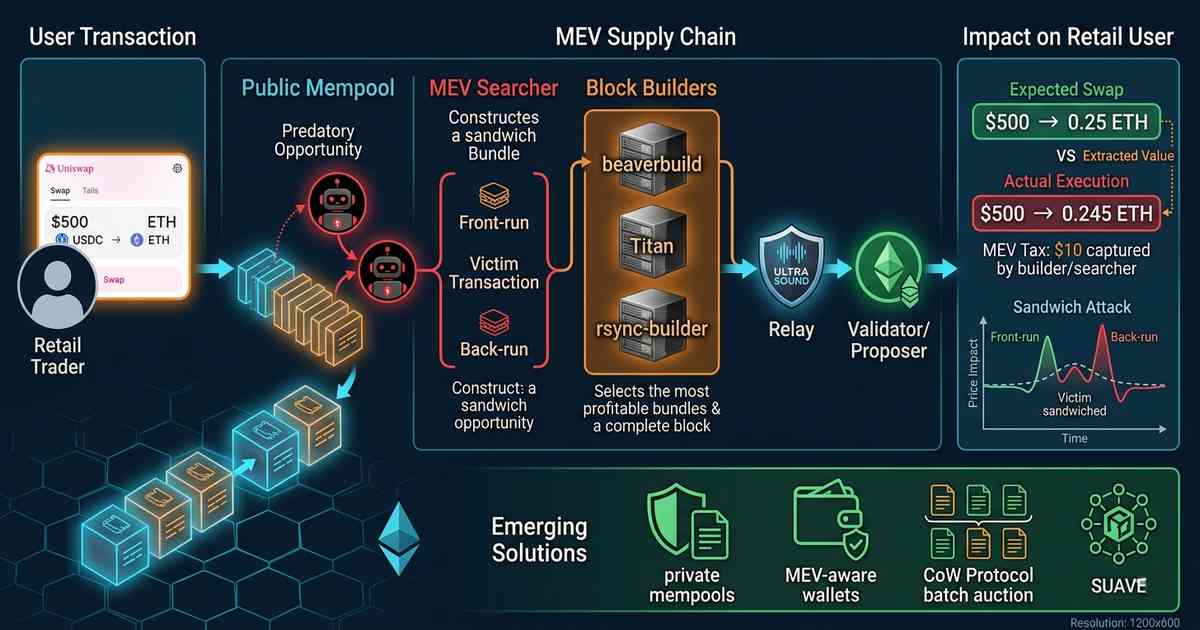
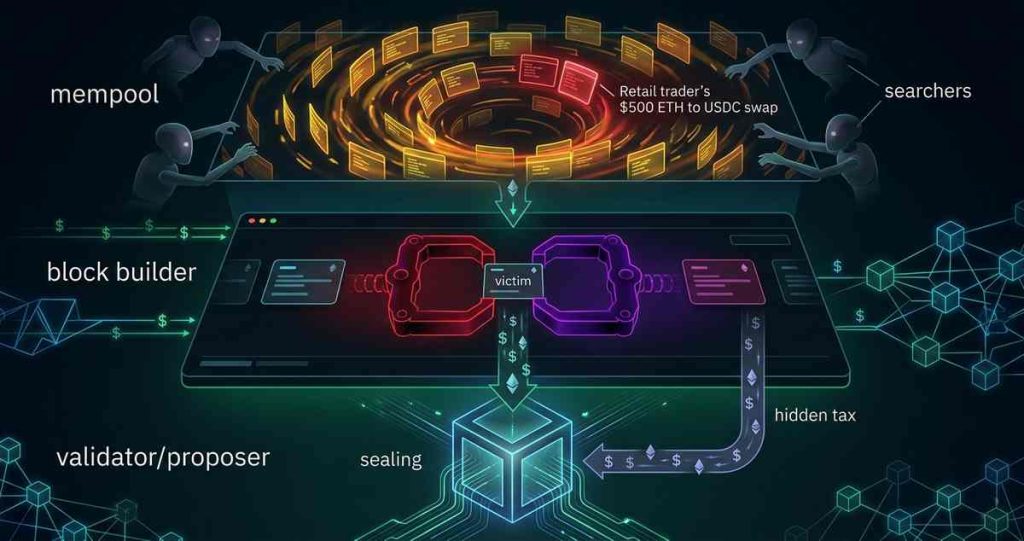
- Sandwich Attacks: The predatory form of MEV that directly harms retail users. A searcher detects a pending swap transaction, places a buy order before it (front-running), allows the user’s trade to execute at a worse price, then sells immediately after (back-running), capturing the difference.
- Time-Bandit Attacks: More sophisticated attacks where validators reorganize blocks after they’ve been proposed to capture MEV from previous blocks. While rare on Ethereum due to consensus rules, they remain possible on chains with weaker finality guarantees.
The MEV Supply Chain: From Mempool to Block
Understanding MEV extraction requires understanding the actors and their relationships:
🔍 Searchers
Searchers are specialized bots—run by individuals, teams, or firms—that monitor the mempool (the queue of pending transactions) for MEV opportunities. When a searcher identifies a profitable opportunity, they construct a bundle of transactions designed to capture that value. Searchers compete fiercely, with advanced algorithms and low-latency infrastructure giving advantage to the fastest.
🏗️ Block Builders
Block builders receive bundles from searchers, along with regular user transactions from the mempool. Their job is to construct the most profitable block possible—selecting and ordering transactions to maximize the total value extracted.
Builders have emerged as the central actors in MEV extraction. Since the introduction of MEV-Boost (Ethereum’s PBS implementation), a small number of builders have dominated block production. In early 2025, the top five builders consistently produced over 80% of Ethereum blocks, creating significant centralization pressure.
✅ Validators (Proposers)
Validators—the entities staking ETH to secure the network—receive fully constructed blocks from builders via MEV-Boost. They select the most profitable block (the one offering the highest tip) and propose it to the network. Validators have no visibility into how the block was constructed or which users were impacted; they simply maximize their own revenue.
🔄 Relays
Relays act as intermediaries between builders and validators, ensuring that builders cannot cheat by sending different blocks than advertised and that validators cannot extract MEV without paying builders. Relays are critical to PBS integrity but also represent a centralization vector—in 2024, a single relay (Ultra Sound) processed over 50% of MEV-Boost blocks.
The Impact on Retail DeFi Users
For retail users swapping tokens, providing liquidity, or borrowing on DeFi protocols, MEV extraction manifests in degraded outcomes:
- 📉 Worse Execution Prices: When a retail swap is sandwiched, the user receives a price that is worse than the quoted market rate by the amount the sandwich bot extracts. For a $500 swap, sandwich extraction might be 0.5-2% — $2.50 to $10 extracted from the user’s trade.
- ⛽ Failed Transactions and Wasted Gas: Retail transactions often fail to land in the mempool at all. Searchers and builders prioritize profitable bundles, and regular user transactions with standard gas fees may be delayed indefinitely.
- 📈 Increased Slippage: Even without direct sandwich attacks, retail trades face increased slippage due to the latency induced by MEV extraction. By the time a user’s transaction lands, arbitrage bots have already moved prices.
- 💧 Liquidity Provider Losses: Liquidity providers (LPs) on automated market makers like Uniswap are particularly exposed to MEV. Arbitrage bots extract value from pools by trading against stale prices.
- ⚠️ Eroded Trust: The cumulative effect is erosion of trust in DeFi. Retail users who experience consistently poor execution may conclude that DeFi is rigged against them.
Solutions: From Mitigation to Democratization
The MEV problem has spawned a thriving ecosystem of solutions aimed at reducing extraction and redistributing value more fairly.
🔒 Private Mempools
The most direct protection for retail users is bypassing the public mempool entirely. Private mempools—like Flashbots Protect, MEVBlocker, and various wallet-integrated solutions—route user transactions directly to builders without exposing them to the public mempool where searchers monitor for attacks.
👛 MEV-Aware Wallets
Wallet interfaces are increasingly integrating MEV protection directly. Rabby Wallet, MetaMask (with certain RPC endpoints), and Rainbow offer transaction routing that minimizes MEV exposure.
🔐 Threshold Encryption and FOCIL
The most promising long-term solution is encrypted mempools—making transaction contents invisible until inclusion is guaranteed. FOCIL (First Come, First Served Inclusion Lists) is a proposal requiring builders to include transactions that meet certain criteria, preventing selective exclusion.
🔄 MEV Redistribution
Some protocols are experimenting with redistributing MEV value to users rather than allowing it to be captured by searchers and builders:
- UniswapX: Uses a filler model where multiple fillers compete to execute swaps, with competition driving execution close to fair market price.
- Cow Protocol: Uses batch auctions where trades are settled through a competition among solvers, eliminating sandwich risk.
- MEV-Share: Allows users to share MEV revenue with builders in exchange for better execution guarantees.
What Retail Users Can Do Today
For retail DeFi users seeking to minimize MEV exposure, several practical steps are available:
- 🛡️ Use MEV-protecting RPC endpoints: Configure wallets to use private mempool endpoints like Flashbots Protect or MEVBlocker.
- 🔄 Use aggregators: Swap through aggregators like Cow Protocol, 1inch, or UniswapX that use competitive filling or batch auctions.
- ⚙️ Set slippage tolerances appropriately: High slippage tolerances signal to searchers that a transaction is sandwichable. Use the minimum slippage that allows execution.
- ⏰ Avoid peak gas times: MEV extraction is highest during network congestion. Timing transactions for lower-activity periods reduces exposure.
- 🌐 Consider alternative chains: Some chains and rollups have lower MEV activity than Ethereum mainnet, though MEV exists everywhere.
Conclusion: From Extraction to Fairness
MEV extraction represents a fundamental tension in blockchain design. The same properties that make blockchains powerful—transparent mempools, deterministic ordering, incentive-driven validation—create opportunities for value extraction at the expense of ordinary users.
The current system, centered around block builders who profit from ordering opacity, has created an uneven playing field where sophisticated actors capture value while retail users experience degraded execution and hidden costs.
But the direction of change is clear: toward transparency, fairness, and democratization. Private mempools, MEV-aware wallets, competitive filling protocols, and next-generation infrastructure like SUAVE are progressively shifting the balance. The goal is not to eliminate MEV—some forms of MEV are essential to protocol function—but to ensure that MEV extraction happens transparently, competitively, and fairly.
For retail DeFi users, the message is neither fear nor resignation. The tools to protect against MEV extraction exist today and are rapidly improving. With awareness and the right tools, retail participants can trade, lend, and provide liquidity on fair terms—participating in DeFi without paying the hidden tax.
Categories: Crypto, Blockchain & Digital Finance
Tags: Block Builders, DeFi, Ethereum, MEV, PBS