
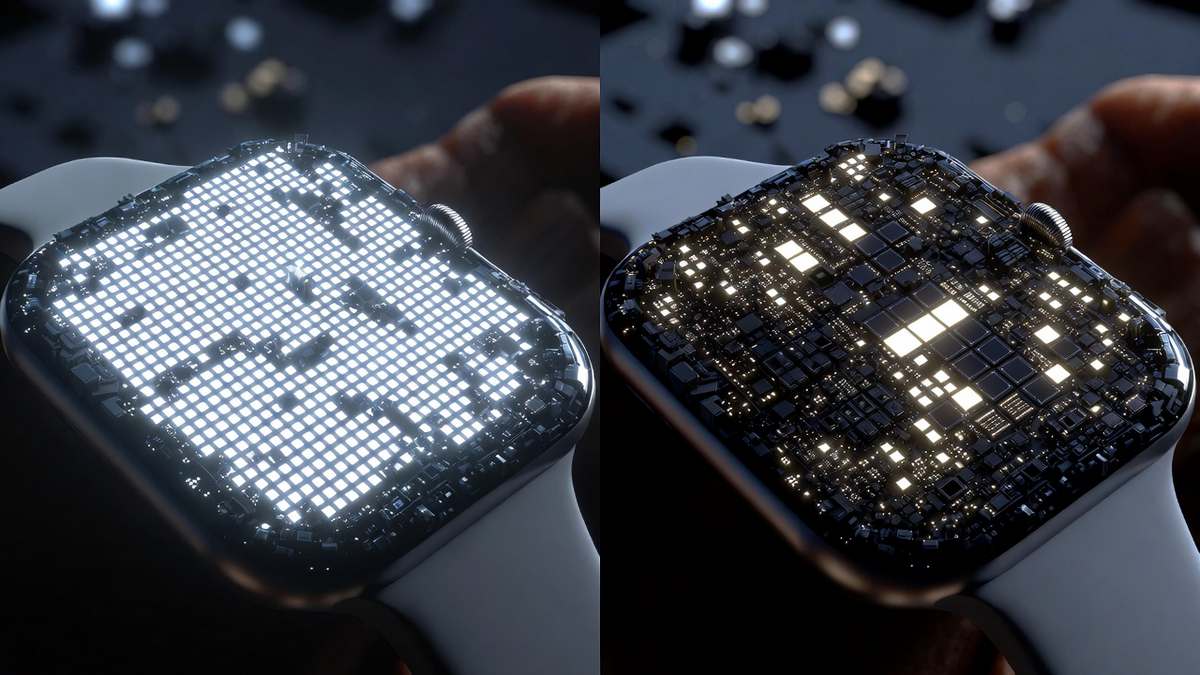
Display technology is becoming one of the most critical differentiators in next-generation wearables. As smartwatches, AR glasses, and AI-powered pins push toward always-on operation and ultra-compact form factors, the limitations of traditional OLED panels are becoming more visible. MicroLED is emerging as a potential successor — but the transition is far from straightforward.
This analysis examines how MicroLED and OLED compare specifically in wearable-class constraints, focusing on power efficiency, brightness behavior, thermal characteristics, and burn-in risk.
Why Wearables Stress Display Technology
Wearables impose harsher requirements than smartphones:
- extremely limited battery capacity
- frequent always-on display (AOD) usage
- high outdoor visibility requirements
- tight thermal envelopes
- long expected device lifespan
Because of these constraints, even small efficiency gains in the display stack can materially affect user experience.
OLED in Wearables: Mature but Constrained
OLED (Organic Light-Emitting Diode) remains the dominant display technology in smartwatches and many AR prototypes.
Strengths of OLED
- Perfect blacks: pixels fully turn off
- High contrast ratios
- Thin and flexible panels
- Mature supply chain
- Relatively lower manufacturing cost today
For current smartwatches, OLED still delivers excellent visual quality per watt in typical UI scenarios.
OLED Weaknesses in Always-On Devices
However, OLED faces structural limitations that become more pronounced in wearables.
1. Organic Material Degradation
OLED emitters are organic compounds that chemically degrade over time. This leads to:
- luminance decay
- color shift (especially blue subpixels)
- uneven aging across the panel
In always-on watch faces, this aging is highly non-uniform.
2. Burn-In Risk
Burn-in occurs when static UI elements age the OLED unevenly.
High-risk wearable scenarios:
- persistent clock elements
- health widgets
- navigation arrows
- status icons
Even with mitigation techniques (pixel shifting, UI dimming), long-term burn-in remains a known OLED weakness.
Future wearable assistants discussed in screenless AI device research may rely on ultra-efficient display technologies.
3. Peak Brightness Efficiency Limits
OLED efficiency drops at very high brightness levels due to:
- efficiency roll-off
- increased thermal load
- faster material aging
This is especially problematic for outdoor-readable wearables.
MicroLED: The Emerging Contender
MicroLED replaces organic emitters with inorganic gallium nitride (GaN) LEDs at microscopic scale.
In theory, MicroLED combines:
- OLED-level contrast
- LCD-level longevity
- superior brightness efficiency
But practical deployment in wearables is still early-stage.
Efficiency Comparison in Wearable Use
Low Brightness (Indoor UI)
At typical smartwatch brightness (50–300 nits):
- OLED remains highly competitive
- MicroLED advantage is modest
- driver overhead can reduce MicroLED gains
Result: Near parity in many UI scenarios today.
Medium Brightness (Outdoor Smartwatch Use)
At 500–1000 nits:
- OLED begins to lose efficiency
- thermal throttling may occur
- MicroLED maintains higher luminous efficacy
Result: MicroLED shows clear efficiency advantage.
High Brightness (AR and Sunlight Conditions)
Above ~1500 nits (common for AR waveguides):
- OLED efficiency drops sharply
- lifetime degradation accelerates
- MicroLED scales much better
Result: MicroLED strongly favored for AR wearables.
Burn-In and Lifetime Analysis
This is where MicroLED’s structural advantage becomes decisive.
OLED Lifetime Characteristics
- Blue subpixel lifetime shortest
- differential aging unavoidable
- mitigation requires software tricks
- heavy AOD usage accelerates wear
Typical smartwatch panels are engineered to survive warranty periods but may show aging over multiple years.
MicroLED Lifetime Behavior
MicroLED uses inorganic emitters that:
- resist chemical degradation
- maintain luminance longer
- show minimal differential aging
- virtually eliminate classic burn-in
However, MicroLED can still experience:
- pixel defects
- transfer yield issues
- uniformity challenges
But these are manufacturing problems, not fundamental physics limits like OLED burn-in.
Thermal and Power Envelope
Wearables are extremely thermally constrained.
OLED Thermal Profile
- heat rises quickly at high brightness
- efficiency roll-off compounds thermal load
- prolonged high-nit operation stresses materials
MicroLED Thermal Profile
- higher luminous efficiency at peak
- better high-brightness stability
- lower heat per nit at outdoor levels
This makes MicroLED particularly attractive for always-visible AR displays.
Manufacturing Reality in 2025
Despite its technical advantages, MicroLED still faces significant hurdles.
Key Challenges
- mass transfer yield
- subpixel alignment precision
- cost per panel
- driver integration complexity
- small-panel uniformity
For smartwatch-sized displays, yields are improving but still expensive compared to OLED.
Where Each Technology Wins
OLED remains best for:
- mainstream smartwatches (2025)
- flexible or curved wearables
- cost-sensitive devices
- thin ultra-light displays
- low-to-medium brightness use
MicroLED is strongest for:
- AR glasses
- outdoor-first wearables
- long-lifespan devices
- ultra-high brightness needs
- premium future wearables
Bottom Line
OLED continues to dominate current wearable displays due to maturity, cost efficiency, and excellent low-brightness performance. However, its organic nature imposes unavoidable constraints in burn-in, peak brightness efficiency, and long-term luminance stability.
MicroLED, while still scaling manufacturing, offers a fundamentally superior physics foundation for next-generation wearables — particularly in always-on and high-brightness scenarios. Through the rest of the decade, the wearable market will likely remain hybrid: OLED for volume products and MicroLED gradually expanding into premium and AR-focused devices.
References
- Choi, S., & Davies, P. (2025). Longevity and Power Efficiency: MicroLED vs OLED for Smartwatches. Journal of the Society for Information Display, 33(2), 110-120.
- Apple Inc. (2024). Display Technology Comparison for Future Wearables. Apple R&D Summary.