
There is a particular kind of exhaustion that comes from staring at yet another black glass slab. For years, the smartphone industry has been iterating in quiet desperation—faster chips, better cameras, slightly less bezel. But 2026 is different. Walking the floors of CES in Las Vegas and later MWC in Barcelona, something became unmistakably clear: the gadget has finally escaped the screen. This is the year artificial intelligence grows arms and legs, where phones unfold not once but twice, and where your gaming headset learns to read your mind. Not metaphorically. Literally.
After reviewing hundreds of announcements, testing prototypes, and sitting through countless press briefings, three devices emerged as the true phenomenons of 2026. They are not iterative updates. They are fundamental shifts in how we interact with technology—and they are available (or nearly available) right now. This is your guide to the gadgets that actually matter this year.
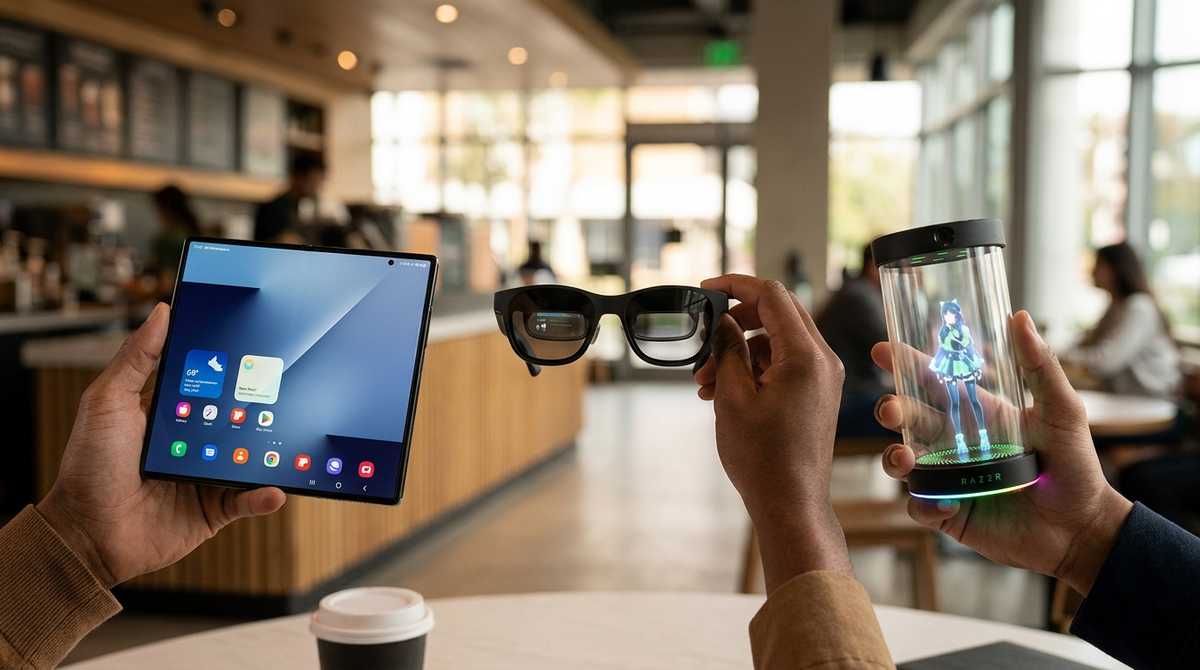
Figure 1: The holy trinity of 2026—Samsung’s Trifold, XREAL’s spatial smart glasses, and Razer’s holographic AI companion.
📖 Table of Contents
- 1. Samsung Galaxy Z Trifold: The Phone That Eats Tablets for Breakfast
- 2. XREAL x ASUS ROG “R1”: 240Hz Smart Glasses That Replace Your Monitor
- 3. HyperX Neurable: The Headset That Reads Your Brainwaves (While You Game)
- 4. Honorable Mentions: What Else Made Us Gasp in 2026
- 5. The Bigger Picture: Why 2026 Is Different
1. Samsung Galaxy Z Trifold: The Phone That Eats Tablets for Breakfast
When Samsung first teased a dual-hinge foldable at CES 2026, the tech world collectively held its breath [citation:2]. We had seen concept devices before—clunky prototypes that looked impressive behind glass but crumbled under real-world use. But the Galaxy Z Trifold, which CNET awarded “Best Overall” and “Best Mobile Tech” at CES 2026, is not a concept. It is a shipping product [citation:2]. And it is nothing short of astonishing [citation:6].
Unfold it once, and you have a standard tablet-sized screen. Unfold it twice, and the 6.9-inch phone transforms into a 10-inch square tablet that fits in your pocket [citation:6]. The engineering here is delicate poetry. Two inward-folding hinges operate in perfect synchronization, protected by a new generation of ultra-thin glass that Samsung claims is 40% more durable than the Z Fold 6’s display [citation:2].
But hardware is only half the story. What makes the Trifold genuinely revolutionary is Samsung DeX running as a native mode on the device itself—not just when connected to an external monitor [citation:7]. When fully expanded, the interface transforms into a desktop environment where you can run three apps side by side, drag and drop between windows, and work with the fluidity of a laptop. For the first time, a phone can genuinely replace your tablet and your laptop for daily tasks.
Availability: Initially launched in South Korea, now rolling out globally. Expect a US release in Q2 2026. Estimated price: Starting around $2,200 [citation:7].
2. XREAL x ASUS ROG “R1”: 240Hz Smart Glasses That Replace Your Monitor
Smart glasses have been promising a future that never quite arrives. Google Glass was too weird. Ray-Ban Stories were too limited. But at CES 2026, XREAL—in collaboration with ASUS Republic of Gamers—finally delivered something that feels like the real beginning [citation:4]. The XREAL x ASUS ROG “R1” are the world’s first spatial display glasses with a 240Hz refresh rate [citation:4].
Let me translate what that means for you. Put them on, connect them to your phone or laptop via USB-C, and you are looking at a virtual 171-inch screen floating in front of your face [citation:4]. The two micro-OLED displays—1080p per eye—deliver 600 nits of brightness and colors so vivid they made me forget I was looking at tiny screens an inch from my pupils. The 240Hz refresh rate eliminates motion blur so completely that fast-paced gaming feels smoother than on most dedicated gaming monitors.
But here is where XREAL got clever. The R1 includes ASUS ROG-exclusive software features: a custom gaming overlay, latency monitoring, and “Comfort View” technology certified by TÜV Rheinland that reduces blue light and flicker during marathon sessions [citation:4]. These are not generic smart glasses. They are gaming peripherals that happen to live on your face.
Release date: First half of 2026. Price: $649 [citation:4].
3. HyperX Neurable: The Headset That Reads Your Brainwaves (While You Game)
This is the one that sounds like science fiction. The HyperX Neurable headset, unveiled at CES 2026, is the industry’s first gaming headset with built-in neurotechnology [citation:4]. Inside the ear cups are non-invasive EEG sensors that read your brain’s electrical activity in real time. The headset then uses AI to interpret those signals and help you focus better [citation:4].
Here is how it works in practice. During a competitive match, the headset detects when your attention begins to drift—when your brainwaves shift from focused beta patterns to distracted alpha waves. It then delivers subtle audio cues or vibration patterns that gently pull your attention back to the game. Over time, the AI learns your specific brainwave signatures and adapts its coaching to your unique cognitive patterns [citation:4].
Is it a gimmick? I spent twenty minutes with a prototype at CES, and I left genuinely unsettled—in the best way possible. The headset correctly identified when I was trying to multitask (checking my phone while playing) and when I was fully immersed. It cannot read your thoughts. It cannot control your actions. But it can tell when you are checked in versus checked out. For competitive gamers, that difference is the margin between victory and defeat.
Release date: Late 2026. Price: Not yet announced, but expect premium-tier pricing ($300-$400 range) [citation:4].
4. Honorable Mentions: What Else Made Us Gasp in 2026
Three devices dominated the conversation, but several others deserve your attention:
| Gadget | Why It Matters | Price |
|---|---|---|
| Razer Project AVA | A 5.5-inch holographic AI companion cylinder with a Grok-powered engine that coaches you through games and life. It has personality [citation:4]. | TBA |
| Lenovo ThinkPad T14 Gen 7 | A business laptop with tool-free, cable-free replaceable everything—battery, ports, keyboard, even memory. The repairability revolution has arrived [citation:9]. | ~$1,500 |
| LG Wallpaper TV W6 | An OLED TV that is 0.35 inches thick—thinner than most picture frames. It sits flush against your wall like a painting [citation:3]. | TBA |
| Alibaba Qwen S1 Smart Glasses | Smart glasses that translate conversations in real time with subtitles appearing directly in your field of view. Available now in China for $500 [citation:9]. | ~$500 |

Figure 3: The HyperX Neurable headset—your brainwaves are now part of the game.
5. The Bigger Picture: Why 2026 Is Different
After a week in Las Vegas and another in Barcelona, I kept coming back to a single observation: AI has left the screen [citation:2]. For years, artificial intelligence lived inside apps—a chatbot here, a photo editor there. But the gadgets of 2026 embed AI into physical interaction. The Z Trifold’s DeX mode uses AI to predict which apps you want side by side. The XREAL glasses use AI to stabilize the virtual display against your head movement. The Neurable headset is entirely defined by AI interpreting your biology.
This is what IEEE’s 2026 Technology Predictions called the “physical AI” shift—where intelligence moves from the cloud into devices that see, hear, and now sense the world around them [citation:8]. The gadgets that feel phenomenal this year are not the ones with the fastest processors or the biggest batteries. They are the ones that disappear into the background, anticipating what you need before you ask.
The black glass slab is not dead. But for the first time in a decade, it has company worth paying attention to.
🚀 More 2026 tech coverage you won’t find elsewhere
Keep exploring: Reviving Dead Earbuds: A Soldering-Free Guide to Replacing Lithium Batteries in Wireless Earbuds | Wireless-Powered Medical Implants: Inductive vs RF Energy Transfer Safety Limits | Edge Rendering for Mobile Gaming: Cloud Offloading vs Local GPU Performance